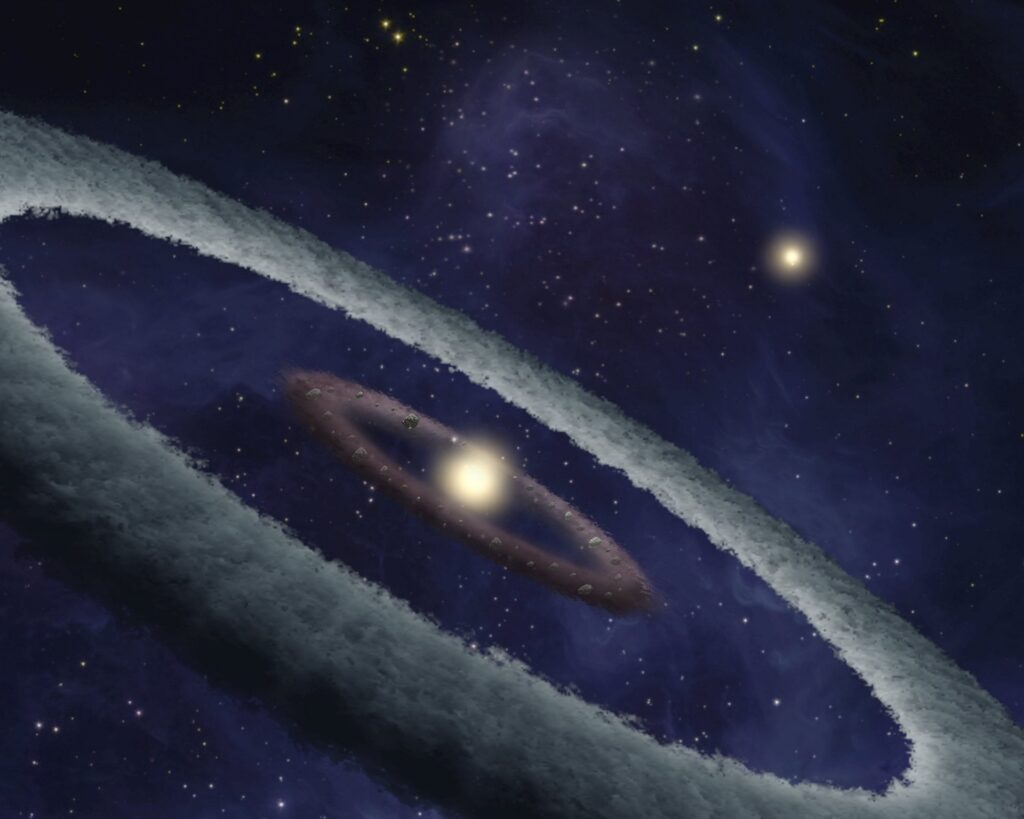
Astronomers comparing 114 single, sunlike stars found that the disks around young stars were misaligned with their stars’ equators about as often as planetary orbits were in older systems. The researchers also found no detectable trend with orbital distance. The comparison suggests that large shifts in orbital tilt after planets form are uncommon in the systems studied, said Lauren Biddle, an astrophysicist at Princeton University.
Biddle and co-author Brendan Bowler examined stellar obliquity: the angle between a star’s spin axis and an axis perpendicular to the plane of a surrounding disk or a planet’s orbit. If a planet orbits in the plane of its star’s equator, the two axes line up. A tilt between them can offer a clue to the system’s history. Gravitational pulls from other planets or stars can change an orbit’s orientation; for a giant planet close to its star, tidal interactions may also matter.
In a paper accepted for publication in The Astronomical Journal, the researchers compared 49 systems with protoplanetary disks, where planets were beginning to form, and 24 with debris disks. The planet sample included 21 warm Jupiters, which take 10 to 100 days to orbit their stars, and 20 hot Jupiters, which typically complete an orbit in less than 10 days. Comparing systems of different ages allowed the team to look for signs of change without tracking any one orbit over its lifetime.
The observations establish only a lower limit on the tilt: the true angle between the axes can be larger. Every system the team classified as misaligned had a tilt of at least 10 degrees, Biddle said. She put the average for the misaligned systems at roughly 30 to 50 degrees.
The findings do not extend to all planetary systems. The team excluded hot stars and stars with close stellar companions. Its planet sample covered giants that pass in front of their stars as seen from Earth, not small planets or non-transiting giants on wider orbits. Large tilts could be common in those groups, Biddle said.
The study did not test whether planets can support life. Biddle said there is no evidence that stellar obliquity itself affects habitability. Its relevance is indirect: a tilt can help astronomers understand how planets formed and how they reached their present orbits. Where a planet ends up relative to its star matters for habitability.