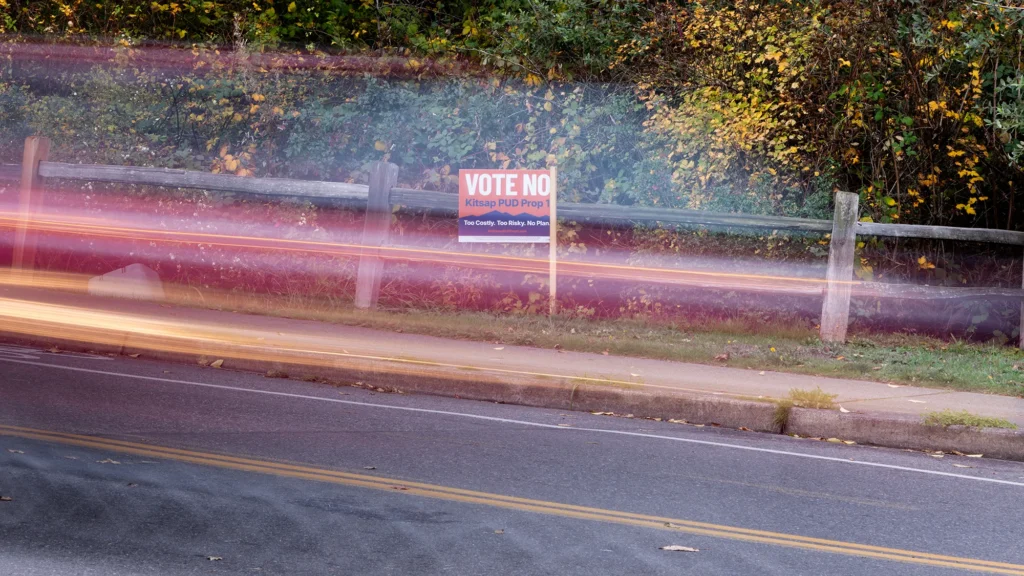
Reporting published on November 24, 2026, described how climate-focused candidates elsewhere treated that month’s midterm elections as a win, using frustration over the cost of living and high power bills to defeat fossil-fuel-friendly challengers for Congress, governorships, and local offices. Voters in two communities, however, rejected proposals to replace for-profit electric utilities with publicly owned ones: Kitsap County, Washington, and Ann Arbor, Michigan.
On average, public utilities in the United States charge lower electric rates and offer more reliable service than for-profit providers. Advocates argue that utilities accountable to communities rather than shareholders could also move to cleaner energy faster. The two 2026 efforts, in different regions, followed similar paths. In each case a private utility spent roughly $2 million on a local opposition campaign and used overlapping language such as “too costly” and “too risky.” Both measures failed by single-digit margins, the same outcome as most recent public-power efforts nationally. Creating a new public utility in the 21st century usually means buying poles and wires already owned by a for-profit company, a process closer to a contested acquisition than to building a grid from scratch.
Kitsap County, Washington
Public power has been part of Washington’s history for nearly as long as the state has existed, and the movement accelerated in the 1930s. A citizen-led statewide ballot measure gave communities the right to form public utility districts, or PUDs, run by elected commissioners and empowered to provide power, water, and later internet without taking a profit. Congress then created the Bonneville Power Administration, a New Deal agency that sold Columbia River hydropower and was required to give public utilities first claim on that cheap electricity. Dozens of districts formed in the following decades.
Kitsap County, on the peninsula across Puget Sound from Seattle, formed a PUD intended to provide electricity during that period. World War II delayed the effort long enough that the authorization expired. The district now oversees water and internet service while the investor-owned utility Puget Sound Energy supplies power.
By the 1950s, opposition framed public power as a political threat. Steve Johnson, former executive director of the Washington Public Utility Association, said private utility groups ran national magazine ads calling it “creeping communism” and showing pictures of Russian dictators. Most later community efforts in Washington and across the country failed. A notable exception came in 2008, when neighboring Jefferson County passed a ballot initiative to take power service from Puget Sound Energy. Johnson called that result a wake-up call because no new PUD had been created since the 1950s. Jefferson County now runs entirely on carbon-free electricity from Bonneville Power, and typical bills there are roughly 19 percent lower than those paid by Puget Sound Energy’s 1.24 million customers in surrounding areas.
Kitsap County is home to about 280,000 people. Over the five years before the 2026 vote, the average power bill nearly doubled, and Puget Sound Energy is proposing a series of increases totaling 32 percent by 2029. The company told Grist that its rates reflect rising demand, infrastructure costs, and the challenge of meeting Washington’s clean-electricity targets. State law requires utilities to be carbon neutral by 2030. Puget Sound Energy still gets about half its energy from fossil fuels.
Earlier in 2026, as bills with new rates arrived, Kitsap utility commissioners heard from residents who were struggling. Commissioner Heather Pauley said, “Not being able to decide between feeding your kids and paying your electric bill — it’s not OK.” The district placed a ballot initiative before voters asking for authority to take over power service from Puget Sound Energy. One commissioner described the design as having an “Achilles’ heel”: voters would approve the idea without an official feasibility study. If the measure passed, the district would pay for an extensive study of costs and benefits and would proceed with a grid takeover only if the numbers worked. The approach was meant to show fiscal caution, but it also left voters with few details.
That gap became the opening for the company’s campaign, whose flyers and yard signs read “Too Costly. Too Risky. No Plan.” The opposition spent $2.3 million, making the fight one of the most expensive local ballot-measure campaigns in state history. The public utility district was strictly prohibited from advocating. General manager Angela Bennink said, “Was there misinformation out there? Absolutely,” but added that the district was limited in what it could do. Unplug PSE, a grassroots campaign organized by Johnson and other Kitsap residents, supported the initiative on a total budget of $9,000.
Puget Sound Energy also argued that a takeover would be too expensive, though much of that cost would come from the company itself. During Jefferson County’s buyout negotiations, the utility had demanded $109 million for its power lines and transformers, more than double their assessed value. It was later ordered to return nearly $53 million of those extra proceeds to ratepayers. This time the company told Grist it might not agree to sell at all, which would force an eminent-domain fight.
With many voters focused on affordability, the missing financial detail was a difficult sell. Fran Korten, chair of Unplug PSE, said, “The ‘No Plan’ of that argument certainly sank in with a lot of people that we talked with.” The proposition received only 42 percent approval. The district can still conduct a feasibility study and could try again for public power in 2028. Bennink said a critical window might be closing. Bonneville Power’s legacy dams and nuclear resources, which a Kitsap public utility would rely on for affordable power, are stretched thin. She said the administration currently has enough cheap power to cover about 60 percent of the county’s electricity needs, but another new public utility could claim that power first. Puget Sound Energy said the district could then face many of the same market challenges the private utility faces.

Ann Arbor, Michigan
Public power in Michigan began largely out of necessity. In the late 19th century, for-profit utilities had little incentive to serve small, remote communities, so cities and towns built their own systems. The state now has 41 municipally owned electric utilities in small and midsized cities, almost all of them decades old.
Two years before the 2026 midterms, Ann Arbor voters approved a municipal renewable-power utility that residents could opt into. It would not replace the city’s sole power company, the for-profit utility DTE Energy. Instead it would pay for solar panels, batteries, and other equipment feeding the existing grid. As of November 2026, 92 homes in one neighborhood were in the pilot phase, which aims to expand citywide the following year.
Some advocates said that model did not go far enough. It still depends on DTE’s aging infrastructure, and a city analysis indicated that the for-profit utility would not add renewable energy fast enough for Ann Arbor to reach a 100 percent renewable-energy goal by the end of the decade. In 2025, public-power advocates decided to seek a full break from DTE so the city could move to clean energy faster. The 2026 ballot proposal asked whether Ann Arbor should establish a board to lead a transition away from DTE, with the goal of completely replacing the investor-owned utility with one owned and operated by the city.
Fiona Dunlop, a field organizer for Ann Arbor for Public Power, which wrote and campaigned for the proposal, said, “We could make electricity more affordable for people in Ann Arbor. We could make it more reliable,” and “We could take real steps toward good climate policies.” Supporters faced opposition from DTE, labor unions, and the city itself. Brian Geiringer, executive director of Ann Arbor for Public Power, said, “The complexity of our proposal made it easier for our opponents to find inroads to attack.”
DTE put $1.8 million into the Ann Arbor Responsible Energy Coalition, which campaigned against the measure. Using language similar to Puget Sound Energy’s, the coalition argued that public power would be “too costly and too risky” for Ann Arbor and its roughly 125,000 residents. It said a board could include people with little or no technical experience and could leave residents with higher costs. After the election the coalition said, “The people of Ann Arbor saw this proposal for exactly what it was: a mandate that would have made life in Ann Arbor even more expensive by eventually forcing working families to carry the burden of a billion-dollar debt,” referring to the cost of buying and maintaining the infrastructure.
That $1 billion figure is the coalition’s estimate of what it would cost the city to buy DTE’s poles and wires and to maintain them. In a 2023 early-phase feasibility study, the city estimated a buyout could cost anywhere from $281 million to $1.15 billion and noted that Michigan has no modern precedent to point to. Bonds could pay for a purchase, but further financing options would require another feasibility study. The proposal failed by 3.6 percentage points, or 2,003 votes.
Mike Shriberg, a professor of practice and engagement at the University of Michigan’s School for Environment and Sustainability, said Ann Arbor residents, like people elsewhere, are frustrated by rising power bills and unreliable service. He said the high and uncertain costs of public power may have outweighed those concerns for now, and that voters, as in Kitsap County, did not have a full feasibility study. “I don’t think it was actually a debate about the fundamentals of whether public power would be a good thing here in concept,” he said. “It was really about the details.”
What comes next
Bennink said building a new electric utility in the 21st century is “fundamentally different” from the 1930s, when the grid was young and public utilities largely built networks from the ground up. Today the work involves billion-dollar buyouts, well-funded opposition, and private companies that have every incentive not to cooperate. She described the task as “very, very hard,” “Herculean,” and “monumental.”
Some observers still expect interest in public power to grow as frustration with utilities continues. Shriberg said, “As we’ve seen across the country, there’s an incredible amount of pent-up frustration with our electric utilities,” adding that “Costs are too high, the service is too unreliable and too dirty.” The lack of detailed studies may have sunk the Washington and Michigan questions, but some governments are willing to study the option more carefully. In November 2026 the Milwaukee City Council voted unanimously to fund a $1.35 million feasibility study of replacing investor-owned We Energies with a city utility, after Wisconsin’s public service commission approved a rate increase for the company.
In Kitsap County, many supporters are now pushing for a similar study. At a post-election utility-district meeting, a small conference room was unusually full of residents asking commissioners to perform one. Ann Arbor organizers described Election Day as bittersweet: the local public-power proposal failed, but a statewide ballot measure to amend Michigan campaign-finance laws and limit utilities’ influence in elections passed overwhelmingly, including among Ann Arbor voters. The newly elected mayor of Ann Arbor had endorsed the local public-power measure during the campaign, and turnover on the City Council could reopen the question of funding a deeper feasibility study, which failed to pass in 2025. Geiringer said, “The movement is still very much alive, probably stronger than ever.”