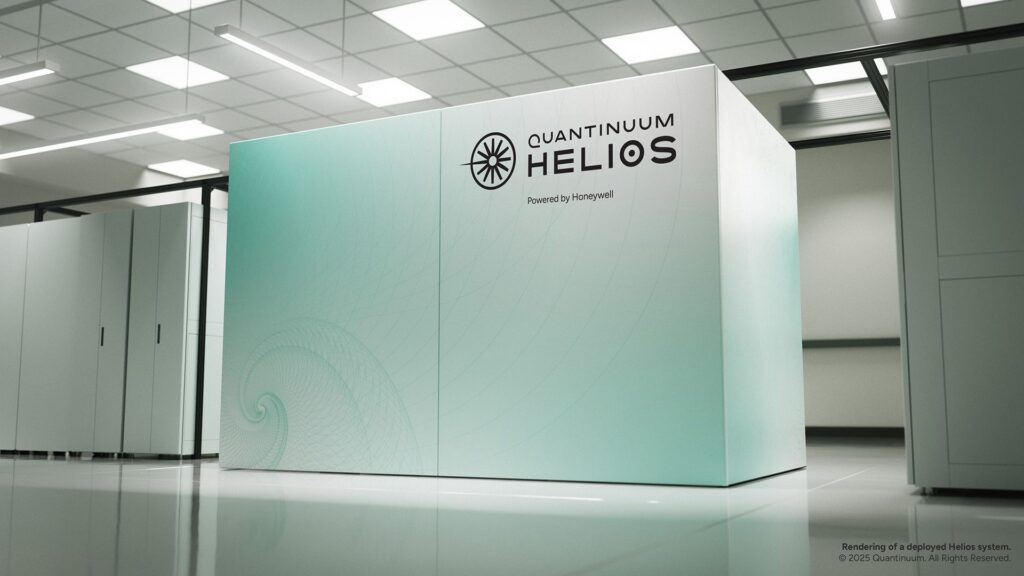
Quantinuum researchers report that their 98-qubit Helios processor preserved quantum information with an estimated failure rate of 0.0005% per round of error checking. That works out to about five uncorrectable errors per million rounds, compared with an estimated 772 per million rounds (0.0772%) in comparable memory tests on Google’s 105-qubit Willow chip.
The Helios team described the result in a preprint posted to arXiv on October 16, 2026, that has not yet been peer-reviewed. The experiment tested how reliably the processor could store quantum information, not whether it could complete a million computational operations without an error.
How adding qubits improved reliability
Quantum error correction spreads information across several physical qubits to create a single logical qubit. This lets the system recover stored information even when noise disturbs some of its components. But each additional physical qubit can also introduce errors, so the key question is whether the extra protection outweighs that risk.
The researchers tested three sizes of a scheme called a color code. The smallest, at code distance 3, could correct one physical-qubit error; distances 5 and 7 could correct two and three, respectively. At each step up in distance, the estimated probability of an uncorrectable error fell by a factor of about 12. The largest code yielded the reported rate of roughly one failure per 200,000 rounds.
Unlike Willow, which uses superconducting circuits, Helios stores information in charged barium ions. The team could move ions to bring different pairs together, allowing them to interact directly rather than pass information through intermediate qubits that could introduce errors. The researchers also used a technique called leakage repumping: brief laser pulses returned ions to a usable state when they slipped outside the states used to store information.
What the test says about larger machines
Quantinuum representatives estimate that a future trapped-ion machine could support 100 logical qubits with about 30,000 physical qubits, compared with about 900,000 for a competing superconducting system. Those figures are projections, not hardware requirements demonstrated by the memory test.
Robin Blume-Kohout, co-director of Sandia National Laboratories’ Quantum Performance Lab, who was not involved in the study, said a scaled-up version could reach the reliability needed for useful fault-tolerant computation with fewer than a million physical qubits. Dave Hayes, Quantinuum’s director of computational design and theory, said substantial engineering work remains both to build larger systems and to integrate the elements needed for fault-tolerant computation.