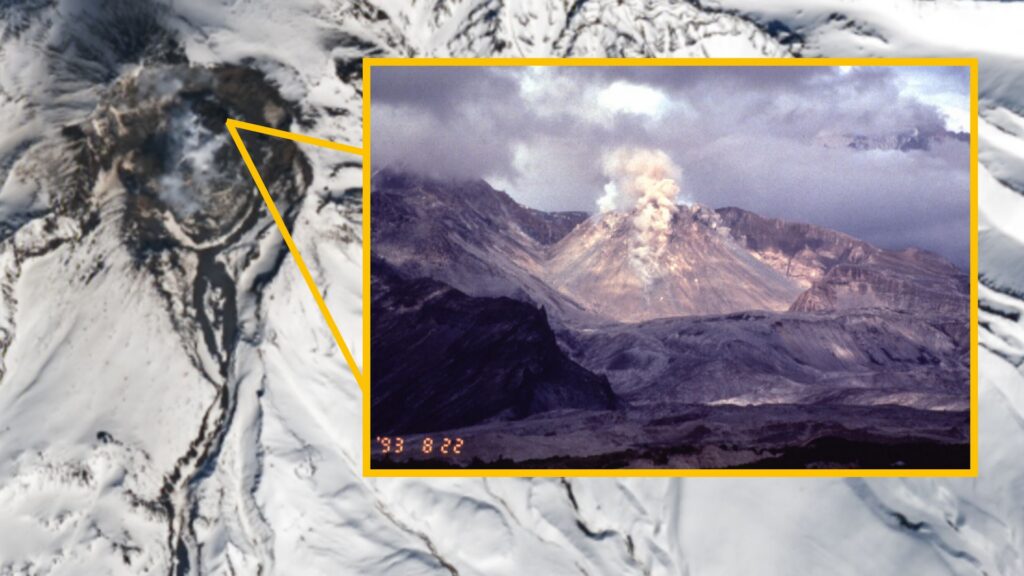
A dark circle stands out against the snow in the horseshoe-shaped summit caldera of Shiveluch, a volcano on Russia’s Kamchatka Peninsula. NASA’s Earth Observatory identified it as a rapidly growing lava dome in an image Landsat 9 took on April 23, 2026. As of the November 24, 2026 report, it was unclear whether the dome had since collapsed.
A lava dome forms when lava emerges slowly from a vent and piles up rather than flowing far down the slope. The Earth Observatory compared the process to squeezing toothpaste from a tube: the accumulating lava can form rounded lobes or jut upward in spines. As a dome grows, it can give way under its own weight. Volcanologist Janine Krippner told the observatory that Shiveluch has repeatedly rebuilt itself after collapses ranging from the loss of a dome to the failure of an entire flank.
Farther down the slopes, narrow black streaks trace older lava flows. According to Space.com, flows laid down months or even years earlier still held enough heat to melt fresh snow. During an earlier field visit, Krippner could still feel heat coming from flows more than five years old. The broader dark patches beyond the slopes have a different origin: the Earth Observatory identified them as pyroclastic ash from a 2023 eruption that burned large parts of a nearby forest.
At 3,283 meters (10,771 feet), Shiveluch is the northernmost active volcano on the peninsula. The Smithsonian Institution’s Global Volcanism Program recorded at least 15 eruptions there in the century preceding the report. The latest eruptive period began in 1999 and was still underway in November 2026.