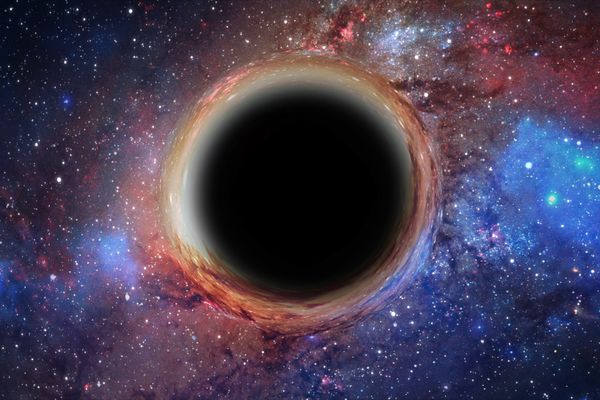
Astronomers estimate that the Milky Way contains at least 100 million stellar-mass black holes. As of November 2026, they had identified fewer than 100, and most of those were still unconfirmed candidates. The gap reflects what telescopes can see: hot gas falling toward a black hole can shine brightly, but a black hole with little matter falling in may reveal itself only through its gravity.
Where the estimates come from
Stellar-mass black holes range from about three to 100 times the mass of the Sun. They can form when a massive star exhausts its fuel and its core collapses. By estimating how many sufficiently massive stars the Milky Way has produced over its lifetime, researchers can infer how many black holes those stars left behind. A 2020 study in Astronomy and Astrophysics estimated about 130 million. A separate 2026 preprint put the figure at about 170 million.
A study published in the January 2018 issue of Monthly Notices of the Royal Astronomical Society took a different route. Researchers used gravitational waves from merging black holes to extrapolate a population of hundreds of millions in the Milky Way. These estimates agree on the broad scale of the population, but none is a direct count.
Finding black holes that aren’t feeding
Most stellar-mass black holes detected in the Milky Way have a companion star from which they draw gas. As the gas collects in a disk around the black hole, it can reach millions of degrees and emit X-rays and gamma rays that space telescopes can detect. An isolated black hole is harder to spot. If it passes directly between Earth and a distant star, its gravity can magnify the star’s light, causing a temporary brightening. Despite numerous surveys, astronomers had identified only one isolated black hole in the Milky Way this way.
A companion star can also reveal a black hole without supplying it with gas. The European Space Agency’s Gaia mission measured the positions of well over a billion stars with enough precision to detect the shifts in a star’s position as it orbits with an unseen companion. Astronomers used those motions to identify Gaia BH1, BH2 and BH3, with masses of 9.6, 8.9 and 33 times the Sun’s mass, respectively. At about 1,560 light-years away, BH1 is the closest known black hole to the Sun. Gaia’s final data release is expected to cover a longer span of observations, making such orbital motions easier to distinguish.
Two companions farther out than expected
The orbits of BH1 and BH2 pose a separate question: how did their companion stars survive? Before collapsing, the massive stars that produced these black holes should have expanded into red supergiants large enough to engulf their companions. Models predict that the stars would then have merged or that the surviving companion would occupy a tight orbit around the black hole. In both systems, the companion appears intact and orbits farther out than predicted.
A modeling study published on July 10, 2026, in The Astrophysical Journal found that the outcome depends on where gas escapes. If gas leaves the system near the companion, it carries away orbital energy and the orbit shrinks. If it escapes near the supergiant instead, it takes less orbital energy with it, allowing the stars to remain apart. The researchers suggested that eruptions might expel gas directly from the supergiant, or that a large difference in the stars’ masses might keep gas from reaching the smaller companion. Neither mechanism has been established for BH1 or BH2.
A fourth candidate system identified in 2024 presents a different puzzle: its proposed black hole has a very low mass and follows an unusually circular orbit. One possible explanation involves a third star engulfed during the red-supergiant phase. The black hole remains unconfirmed, and the orbit is not proof of a past merger.