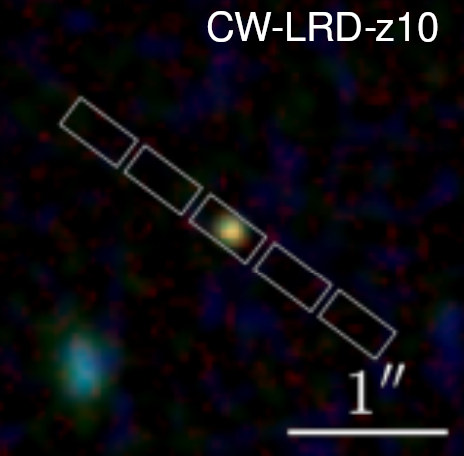
A compact object called CW-LRD-z10 appears to have emitted its light when the universe was just 450 million years old. Its unusually red color could make it the earliest known member of a class astronomers call “little red dots.” But the James Webb Space Telescope observations make a stronger case for when the light was emitted than for what produced it.
CW-LRD-z10 was the only candidate to emerge from a 2025 search using Webb’s Mid-Infrared Instrument (MIRI), according to Takumi Tanaka, a doctoral student at the University of Tokyo and first author of the observational study, published November 24, 2026, in The Astrophysical Journal Letters.
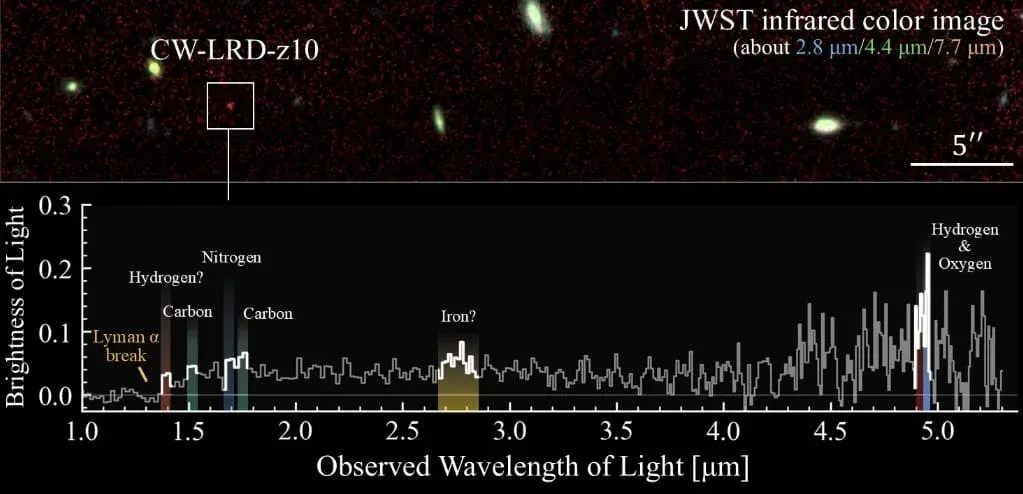
The team identified a sharp drop in the object’s spectrum as a feature called the Lyman-alpha break. As the universe expands, it stretches light to longer wavelengths. The wavelength at which the break appears indicates a redshift of 10.36, placing the object early in cosmic history. Roberto Maiolino, a University of Cambridge astrophysicist who was not involved in the study, told Live Science that the break made the redshift estimate “reasonably robust.”
A different interpretation of the drop would put the object much closer: older stars in a galaxy at a redshift of about 3 could produce a feature called a Balmer break. Tanaka said the observed drop was too strong for a typical stellar population, the galaxy’s color would be difficult to explain, and emission lines expected at that redshift were absent.
What makes it a little red dot candidate?
The strongest clue is the object’s color: it is much redder at mid-infrared wavelengths than in the near-infrared. Its spectrum also has the V-shaped dip seen in other little red dots. But the observations did not cover the wavelengths needed to look for broad hydrogen emission lines, a key signature of the class. Both Tanaka and Maiolino said the object should still be considered a candidate.
One leading explanation for little red dots is that they contain black holes feeding on surrounding material inside dense clouds of gas. The spectrum of CW-LRD-z10 shows hints of iron emission. If confirmed, Tanaka said, that would favor an actively feeding black hole and indicate that the gas around it already contained heavy elements. For now, neither the presence of a black hole nor the object’s role in the formation of supermassive black holes is established.
A star-forming galaxy at redshift 10.36 could also account for the color if it emitted an unusually strong spectral line outside the observed wavelength range. MIRI is scheduled to take another spectrum in 2027. By measuring hydrogen and oxygen emission lines alongside the underlying light, the team aims to distinguish an object that glows red across a range of wavelengths from one that looks red because of intense emission at particular wavelengths.