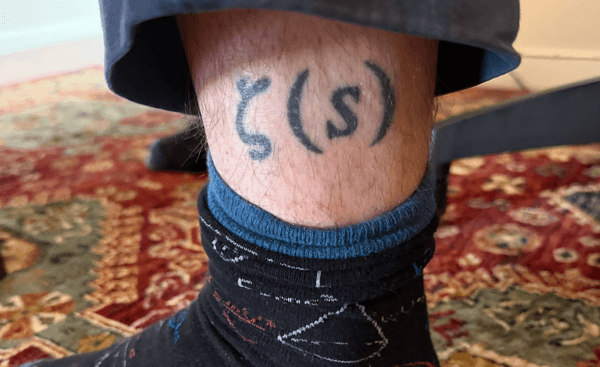
Peter Hall has ζ(s), the zeta function at the heart of the Riemann hypothesis, tattooed on his leg. Yet when he read on November 20, 2026, that Anthropic mathematician Levent Alpöge said he had proved the hypothesis with substantial help from the company’s AI model Claude, Hall felt sick rather than elated. In a November 25 commentary, Hall wrote that outside experts had validated the proof by November 21. What he still wanted to know was how it worked.
Hall had spent about 18 months studying the hypothesis and its connections to prime numbers and cryptography in college before getting the tattoo. One reason the zeta function fascinated him was that the same function could be written in two seemingly different ways: as a sum over positive integers or as a product over primes. Extending the function to complex numbers reveals further connections, including one to the factorial. Alpöge said his proof covered a generalization of the hypothesis to an infinite family of functions.
For Hall, the surprise was never likely to be the verdict itself. Roughly the first 10 trillion zeros tested had satisfied the hypothesis. That was not a proof, but Hall, like many mathematicians, already expected the pattern to hold. What he hoped a proof would deliver was a technique that explained why it held and that mathematicians could use to answer other questions about numbers.
According to Hall, the proof ran to millions of lines of code in the programming language Lean. Alpöge had not released an AI-written explanation; after initially saying it exceeded 250,000 pages, he said on X that the figure was a joke. Hall wrote that some experts thought it could take months or years for people to understand the reasoning.
Hall had previously thought of AI’s impact on mathematics chiefly in terms of jobs: whether mathematicians would find work and what they would be asked to do. The reported proof raised a different concern for him. Checking that an argument succeeds can settle a question, but it does not necessarily give another mathematician the insight needed to build on it.