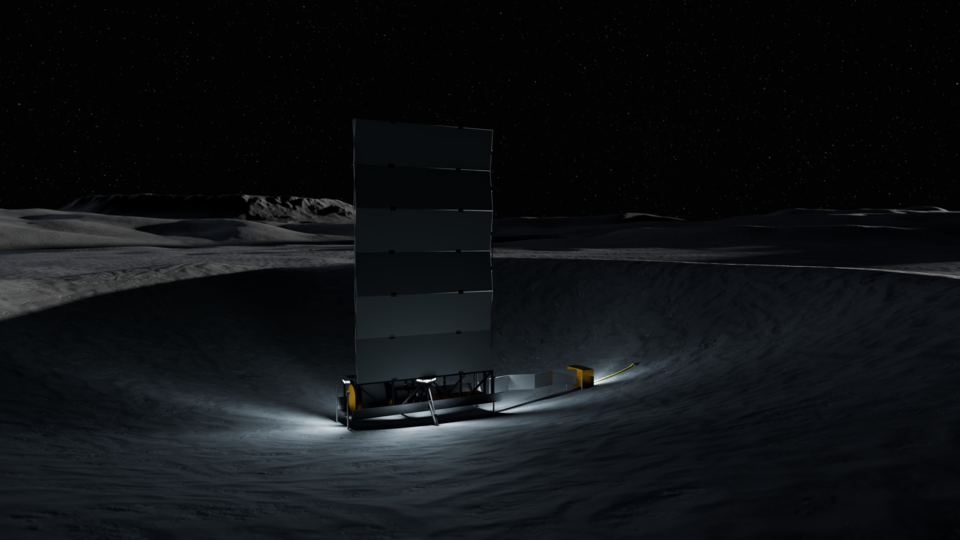
A crater wall near the Moon’s south pole could protect a future crew habitat from radiation emitted by a nearby fission reactor. In a computer simulation of a site called Connecting Ridge, a 120-meter-high wall stood between the reactor and the habitat. The estimated annual dose at the habitat was 0.04 rem from the reactor, in addition to natural background radiation.
Alex Levinsky of Los Alamos led the study with researchers from NASA Glenn, Oak Ridge, Idaho National Laboratory and Lockheed Martin. The team presented the paper, Impact of Terrain on Doses for Fission Surface Power, at the American Nuclear Society’s Nuclear and Emerging Technologies for Space conference in April 2026. The dose estimates come from particle simulations, not measurements on the Moon.
Fission could supply electricity through the roughly two-week lunar night, but shielding is one of the heaviest components of a reactor. The proposed 40-kilowatt system under NASA’s Space Power and Reactor Capabilities program must weigh less than 6,000 kilograms so a rover can carry it. An onboard “shadow shield” can protect nearby control electronics by blocking radiation in one direction. The team investigated whether terrain could do the same for a habitat without adding to the rover’s load.
Using Monte Carlo N-Particle software, the researchers tracked millions of particles from a reactor core positioned 1.5 meters above the surface to represent a rover-mounted system. In idealized landscapes, both a 3-meter-deep crater and a gently sloping hill 3 meters high blocked the direct line of sight to the habitat. In each case, the estimated reactor dose there was about 0.1 rem per year, one-fiftieth of the annual limit of 5 rem above natural background used in the study.
The team then modeled Connecting Ridge, near Shackleton Crater, where some ridges receive sunlight 80–90% of the time and permanently shadowed areas nearby contain water ice. The researchers identified a depression behind the 120-meter crater wall that the rover could reach without crossing slopes steeper than 18 degrees.
The wall’s protection would not extend to astronauts entering the reactor area during operation. Nor would it shield spacecraft passing overhead: lunar soil can scatter neutrons upward, so the site might require a no-fly zone. The low dose estimated for the habitat depends on where it sits relative to the terrain; it does not mean the reactor would be safe to approach.