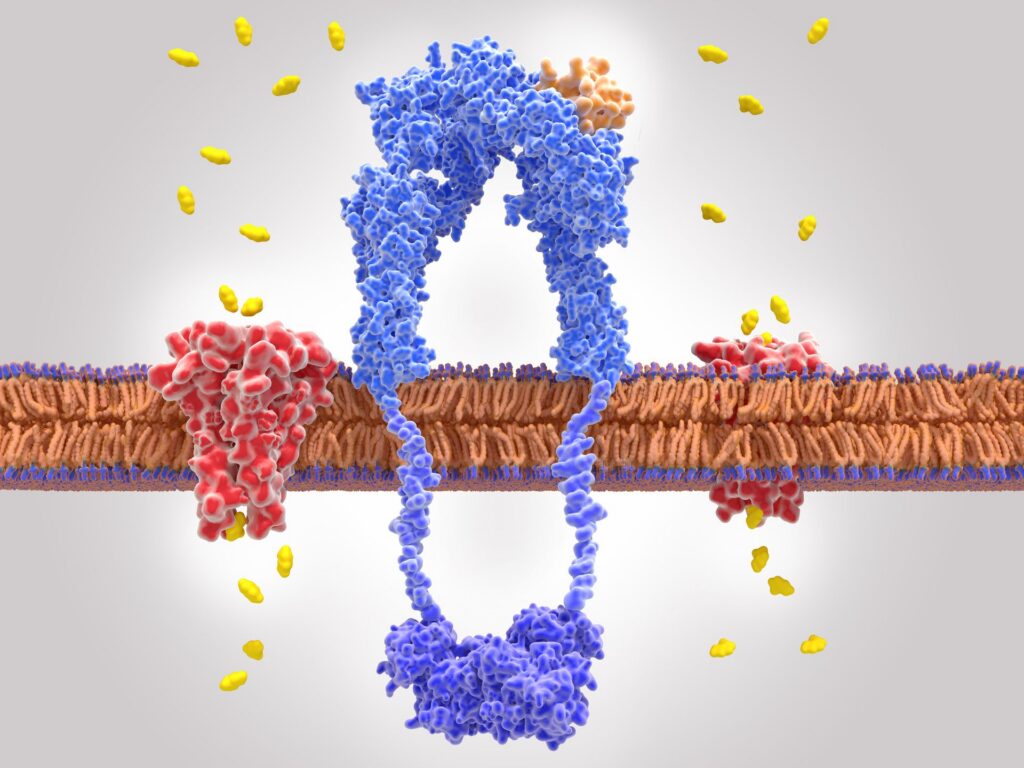
An AI-designed protein called RF-409 lowered blood sugar by roughly 60% within two hours in mice carrying a mutation that prevents insulin from binding to its receptor. An insulin injection produced no substantial drop in blood sugar in mice with the same mutation. The study, published November 25, 2026, in Science Translational Medicine, suggests that a receptor unable to bind insulin can still send the signals needed to lower blood sugar. Whether RF-409 can help people remains unknown.
Normally, insulin binds to a receptor on the surface of a cell and changes its shape, setting off signals that help bring blood sugar down. The mutation tested in the study had been identified in patients with Donohue syndrome, a rare inherited disorder in which blood sugar can rise dangerously high after meals and fall unusually low between them. Affected children grow poorly, and most die before their first birthday. Some patients already produce extremely high levels of insulin, said study co-author Eunhee Choi, a cell biologist at Columbia University. Giving them more may not help if their receptors cannot respond.
Computer models suggested that RF-409 could bypass the damaged part of the receptor and hold it in the shape needed to send a signal. The researchers had developed the protein in 2025 using computational tools including AlphaFold2. In the new study, tests in laboratory-grown mouse and rat cells and in healthy mice showed that RF-409 reproduced most of insulin’s effects on signaling and metabolism. In mice, its half-life in the bloodstream was nearly 60 times that of insulin.
To test the protein against the defect, the team engineered mice to carry the Donohue syndrome mutation. On average, their blood sugar was about 2.5 times that of mice that retained a working copy of the receptor gene, and their fasting insulin levels were about 10 times as high. In a 14-day comparison, five mice given RF-409 continuously maintained their body weight. They also had lower blood sugar, retained more abdominal fat and showed less pancreatic damage than five mice given saline.
More than 150 insulin receptor mutations have been linked to inherited insulin resistance, and the study tested just one. Kalaiarasan Ponnusamy, a computational biologist at SRM Institute of Science and Technology in India who was not involved in the research, said the approach could work for other mutations if the receptor can still transmit signals. It is unlikely to help when a mutation keeps the receptor from reaching the cell surface or leaves it unable to signal at all.
Choi said the team plans to identify which mutations respond, examine the protein’s effects in different tissues and test whether it remains safe and effective with longer treatment. Dr. Rajiv Agarwal, a nephrologist at Indiana University School of Medicine who was not involved in the study, noted that researchers would also need to assess the immune response to RF-409 before it could enter clinical use.