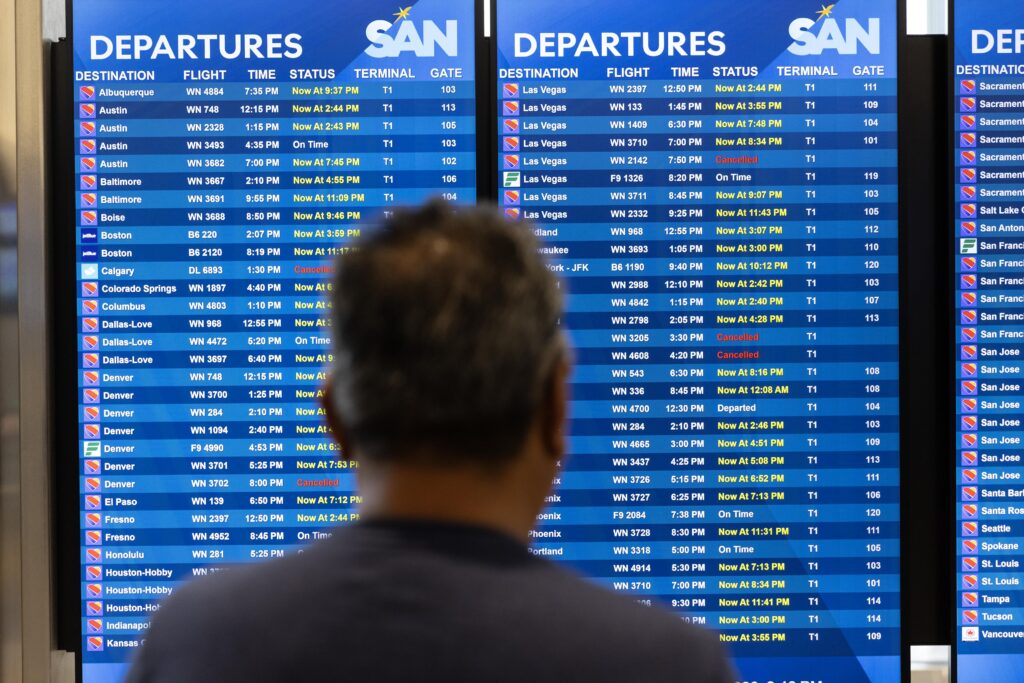
A communications failure led the Federal Aviation Administration to halt departures across US airspace on November 13, 2026. The FAA issued the nationwide ground stop at 3:54 p.m. Eastern time after pilots and controllers reported radio problems. It lifted the stop at 8:15 p.m., but disruption continued through the weekend: FlightAware recorded more than 13,000 cancellations and more than 25,000 delays.
As reported on November 16, the FAA identified its Telecommunications Infrastructure (FTI) network as the system involved. FTI connects more than 4,400 aviation facilities and carries voice and radar data used by air traffic controllers. FAA technicians believed instability in the network interrupted feeds to 17 of the agency’s 22 Air Route Traffic Control Centers and several approach-control facilities.
According to The Wall Street Journal, L3Harris contractors had replaced an old wired telephone switch with a fiber data router at an FAA radio facility in El Dorado, Arkansas, earlier that day. After activation, the router reportedly made hundreds of connection attempts per second. Texas A&M electrical and computer engineering professor I-Hong Hou said the resulting load may have degraded network performance; that explanation was not presented as a confirmed final finding. Contractors took the router and another at a radar facility near Amarillo, Texas, offline, after which the network began to stabilize.
Officials had not established a definitive cause at their initial briefings. Homeland Security Secretary Markwayne Mullin first said there was no cyberattack, then acknowledged that nothing was completely certain. Transportation Secretary Sean Duffy said routers had produced inconsistent data and did not rule out malicious activity. No evidence had emerged for online claims of a cyberattack or involvement by the FAA’s SMART system. FTI was scheduled for replacement in 2028.