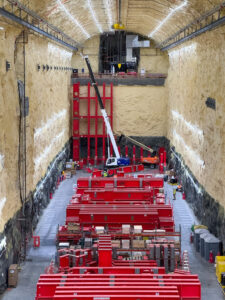
As reported on November 20, 2026, construction had entered a new phase at the South Dakota site of the Deep Underground Neutrino Experiment (DUNE). Fermilab said work on the underground detector facility had begun the previous week. Construction of cryostats for the detector modules began in early November, with crews from CERN, Fermilab and the Sanford Underground Research Facility.
DUNE is designed to study neutrinos using two detectors along an intense neutrino beam. A detector near the beam’s source at Fermilab in Illinois will record particle interactions; a second detector deep underground in South Dakota will make measurements at the far end. The experiment aims to investigate fundamental questions about matter and the evolution of the universe, but it has not yet produced results from this detector system.
More than 1,500 collaborators from over 200 institutions in more than 35 countries are involved. Colorado State University, a founding member of DUNE, contributes to detector development, computing, governance and theoretical neutrino research. CSU physics professor Robert Wilson said the experiment’s science goals have been central to the university’s particle-physics program for more than two decades.
At the time of the report, completion of the South Dakota underground detector space was planned for 2029, with the full apparatus slated for 2030. Those dates are project plans, not completed milestones.