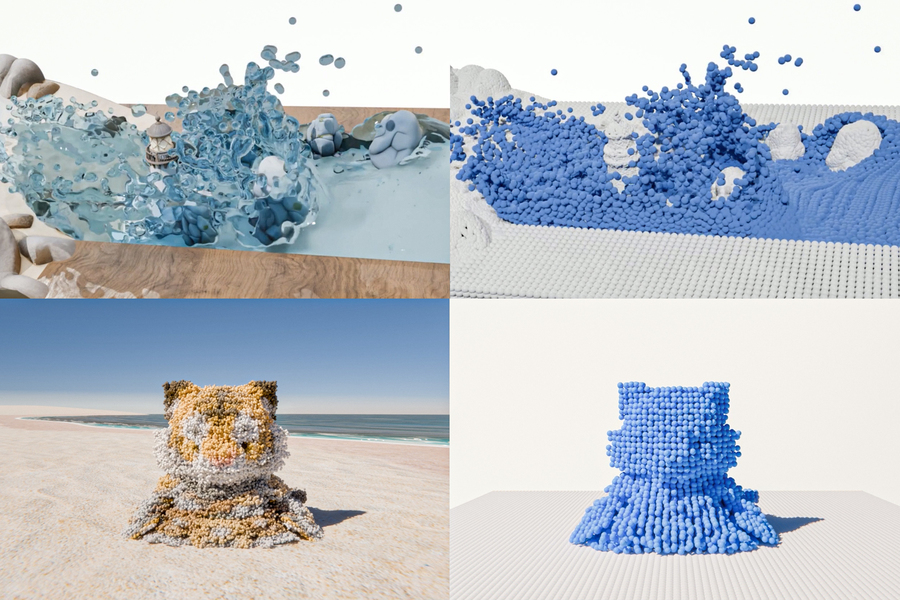
As reported on November 9, 2026, researchers at MIT, the University of British Columbia and other institutions developed WorldParticle, an AI model designed to simulate different physical systems using one architecture rather than a separate solver for each type of material.
The model represents materials as three-dimensional particles. A neural network takes their positions and physical properties and predicts how they will change in the next simulation step. The researchers also designed it to account for external forces and to merge particles to reduce the computational demands of large simulations.
The team demonstrated WorldParticle on six types of physical phenomena, including deformable objects, granular materials and proteins. The researchers reported higher accuracy than the numerical simulation methods used for comparison. MIT postdoc Minghao Guo said the model simulated changes in protein structures about 100 times faster than numerical simulators.
Those tests do not establish that the model can simulate every physical process. Applications mentioned by the researchers—including soft-robot manipulation and the merging of galaxies—remain areas they want to explore, not demonstrated results. The open-access research was scheduled for presentation at the ACM SIGGRAPH conference in Asia.