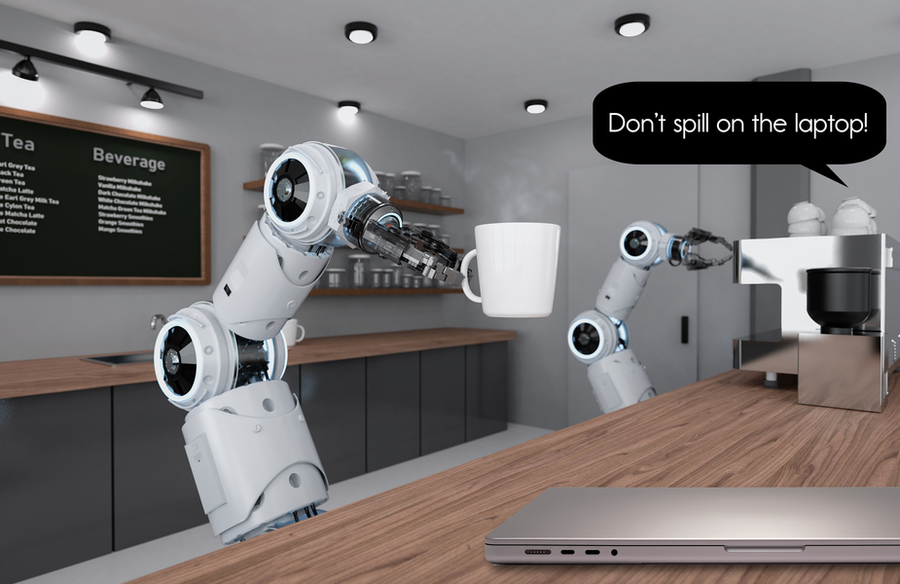
In a report published November 9, 2026, researchers from MIT and New York University described FLEX, a system designed to help robots infer preferences behind conversational instructions. The study was scheduled for presentation at the Conference on Robot Learning later that month. Its demonstrations took place in simulations, not in homes with physical robots.
In one simulated task, a person typed “Don’t spill on the laptop!” while a robotic arm carried a cup of coffee across a cluttered table. FLEX used a large language model to infer a broader preference: avoid spilling on electronics. The robot’s updated path avoided both the laptop and a nearby phone, even though the person had not mentioned the phone.
FLEX works in three steps. It adds an object named in an instruction to the robot’s list of relevant features; uses GPT-4o to generalize from those features, such as inferring that a mug may indicate a preference to avoid fragile objects; and uses computer vision to remove objects no longer present from the list. The researchers said the process takes about five seconds.
Volunteers tested the system by typing instructions to a virtual robot arm in three tasks: serving coffee, moving a candle and carrying a bowling ball. In those simulations, the robot followed the stated instructions and generalized them to avoid electronics, flammable objects and fragile items, respectively.
The work was led by MIT assistant professor Andreea Bobu, with Nathan Dennler of MIT, Audrey Lee and Ilia Sucholutsky of New York University as co-authors. The reported results show how FLEX behaved in the tested virtual scenarios; they do not establish how reliably it would interpret preferences or navigate changing environments with a physical household robot.