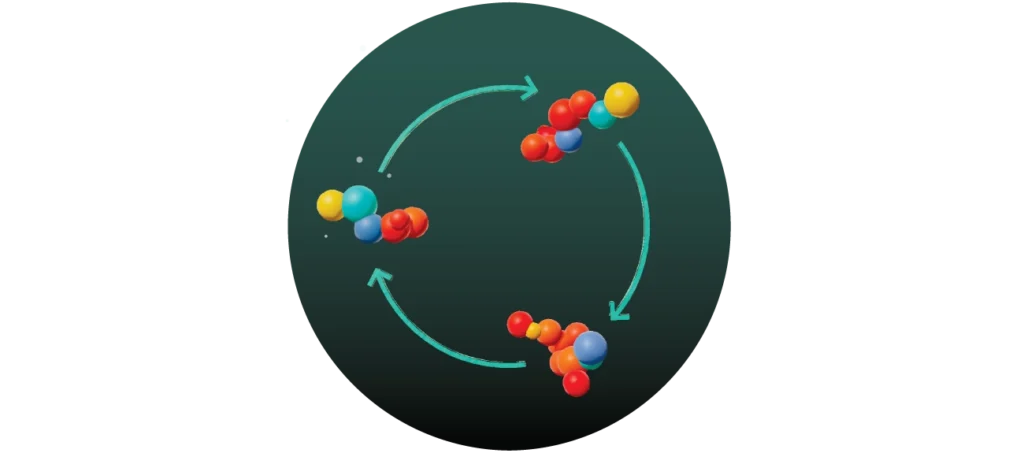
As reported on November 11, 2026, the “metabolism-first” hypothesis proposes that self-sustaining chemical reactions preceded genes and cells. In this account, environmental energy drove networks of simple molecules; RNA and DNA emerged later to store and pass on information. It remains a hypothesis about how life began, not an established account of its origin.
One proposed setting is the seafloor around hydrothermal vents, where heated water carries dissolved metals into the ocean. Iron-sulfide minerals there might have catalyzed early reactions involving hydrogen and carbon dioxide. Those reactions could have produced compounds such as acetate and pyruvate—potential building blocks for more complex chemistry. How such reactions could have persisted and grown more complex is still debated.
Laboratory studies have tested parts of the idea, but not the full path to life. In 2020, evolutionary biologist William Martin and colleagues reproduced temperature and pressure conditions around hydrothermal vents. Using carbon dioxide, hydrogen, and nickel and iron minerals, they produced formate, acetate and pyruvate. Biochemist Martina Preiner, the study’s lead author, described these compounds as central to a metabolic pathway used by some microbes today. The experiment showed that some relevant reactions can occur without RNA or proteins; it did not show that life arose at a vent.
A separate 2020 study by organic chemist Ramanarayanan Krishnamurthy and colleagues found that pyruvate and glyoxylate could react to form nearly all the components of the reverse citric acid cycle under less extreme conditions and without metal catalysts. That result leaves open the possibility that early metabolism-like chemistry occurred somewhere other than a deep-sea vent.
The central gap remains: researchers have not established how initial reactions became stable and complex enough to connect with genetic information. They also need to explain how multiple reactions could coexist within early cell membranes without interfering with one another. The experiments demonstrate chemical possibilities, not a confirmed sequence of events at life’s origin.