Reported November 9, 2026.
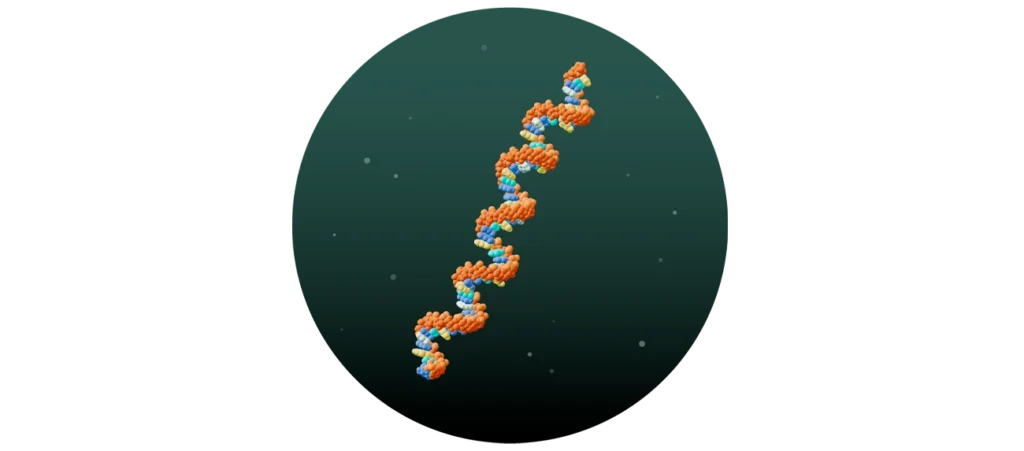
The RNA-world hypothesis proposes that, before cells existed, RNA molecules may have both stored genetic information and helped drive chemical reactions. That combination could offer a way around a problem in modern biology: Cells need proteins to copy and use genetic instructions, but they also need those instructions to make proteins.
RNA can act as a catalyst when it folds into a structure called a ribozyme. In 1996, researchers created a ribozyme that could join nucleotides to form RNA, raising the possibility that RNA-based chemistry could eventually copy and evolve. But laboratory work has also exposed a difficulty. In experiments reported in 2019, Gerald Joyce of the Salk Institute and colleagues found that mutations introduced during artificial evolution usually destroyed their ribozymes’ ability to make other RNA molecules. Those ribozymes were also much larger than the roughly 10- to 15-nucleotide RNA strands that experiments have produced through spontaneous assembly.
Work by Philipp Holliger and colleagues at the MRC Laboratory of Molecular Biology suggests that a smaller catalyst may be possible. Searching for activity in short RNAs through artificial evolution, they identified a 45-nucleotide molecule, QT45, that could take hold of another RNA strand and copy it. They also found two other comparably small RNAs with similar activity in a starting pool of about 10 trillion different molecules. Holliger said QT45 can, in principle, copy any sequence.
These are laboratory results, not evidence that QT45 existed on early Earth or that an RNA world did. Holliger’s team found that cycles of changing acidity and freezing and thawing could drive rounds of RNA copying—conditions the researchers suggest might have been possible near the young Earth’s icy poles. Whether such a suitable setting existed and persisted long enough remains unknown. And even if RNA could copy itself, the first living systems would likely have needed a way to obtain energy and make useful molecules as well.