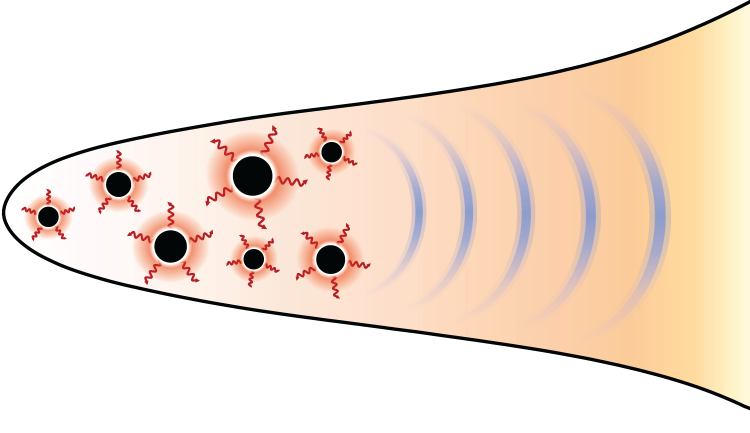
Microscopic primordial black holes could have reheated the universe after its initial rapid expansion without producing gravitational waves strong enough to disrupt early cosmic chemistry. In a computer modeling study published in Physical Review Letters, researchers found that the outcome depended on when the black holes finished evaporating.
Researchers from the PRISMA++ Cluster of Excellence and the Mainz Institute for Theoretical Physics in Germany tested an assumption in earlier models: that primordial black holes all had the same mass. In that case, they would reach the ends of their lives together, producing a strong burst of gravitational waves. The team instead modeled a range of masses up to one billion grams (1,000 metric tons), corresponding to a lifetime of about one second at the upper limit.
With different masses, the simulated black holes finished evaporating at different times. Spreading those events out weakened the gravitational waves enough to preserve early cosmic chemistry while still allowing the black holes to supply the energy for reheating.
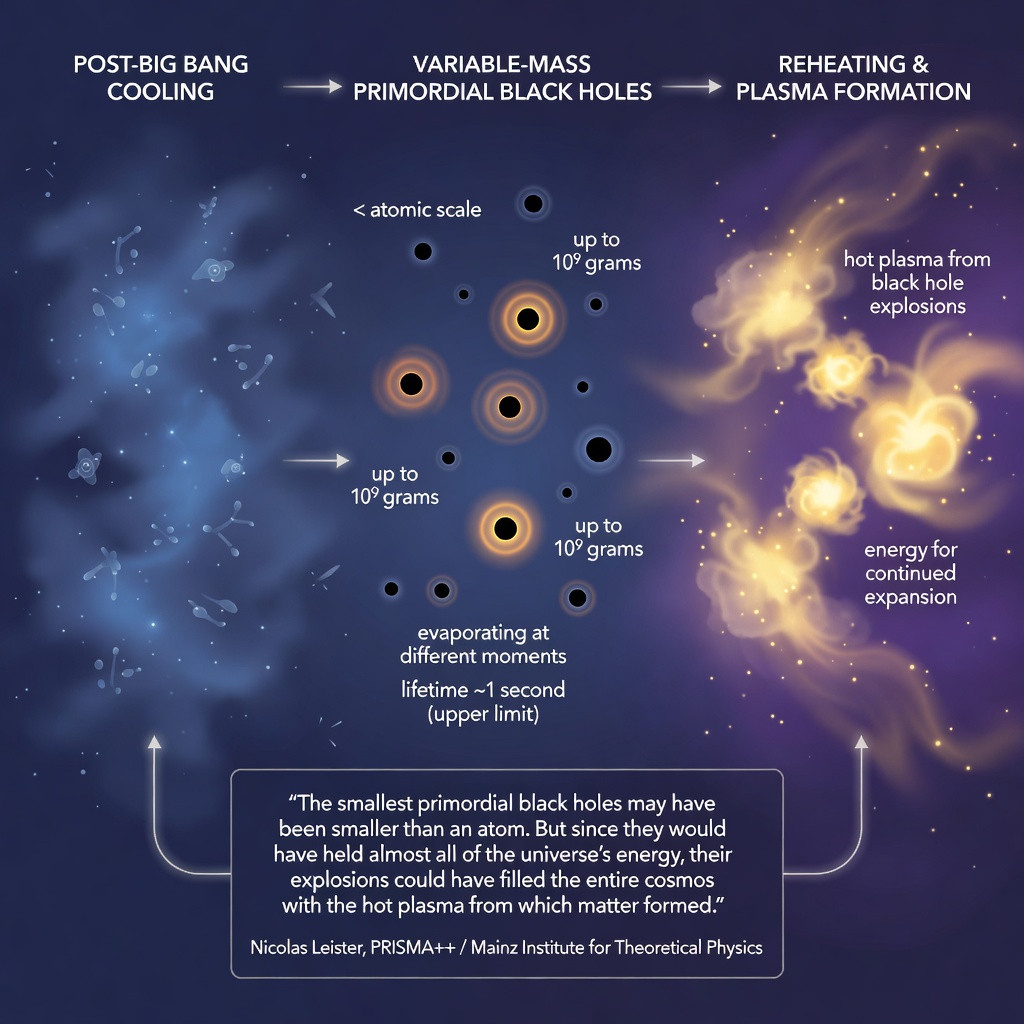
“The smallest primordial black holes may have been smaller than an atom,” said Nicolas Leister, a doctoral student at PRISMA++ and a co-author of the study. “But since they would have held almost all of the universe’s energy, their explosions could have filled the entire cosmos with the hot plasma from which matter formed.”
The simulations show how reheating could have worked if such black holes dominated the early universe. They do not establish that the black holes existed or that their evaporation caused reheating.