The European Southern Observatory (ESO) has called for international review of satellite projects after the U.S. Federal Communications Commission approved SpaceX’s application to launch one million satellites for an orbital AI data center. A peer-reviewed study in Astronomy & Astrophysics found that a constellation of that size and the modeled brightness would leave trails in most long telescope exposures. The results are projections, not observations of a deployed system.
SpaceX’s design, called Starmind, would use nearly continuous sunlight for power, radiators for cooling and lasers to exchange data between satellites. ESO Director General Andreas Kaufer said the observatory had submitted its analysis to the FCC. He argued that the project’s effects on the night sky would extend beyond the borders of the country that authorized it.
What a five-minute exposure would record
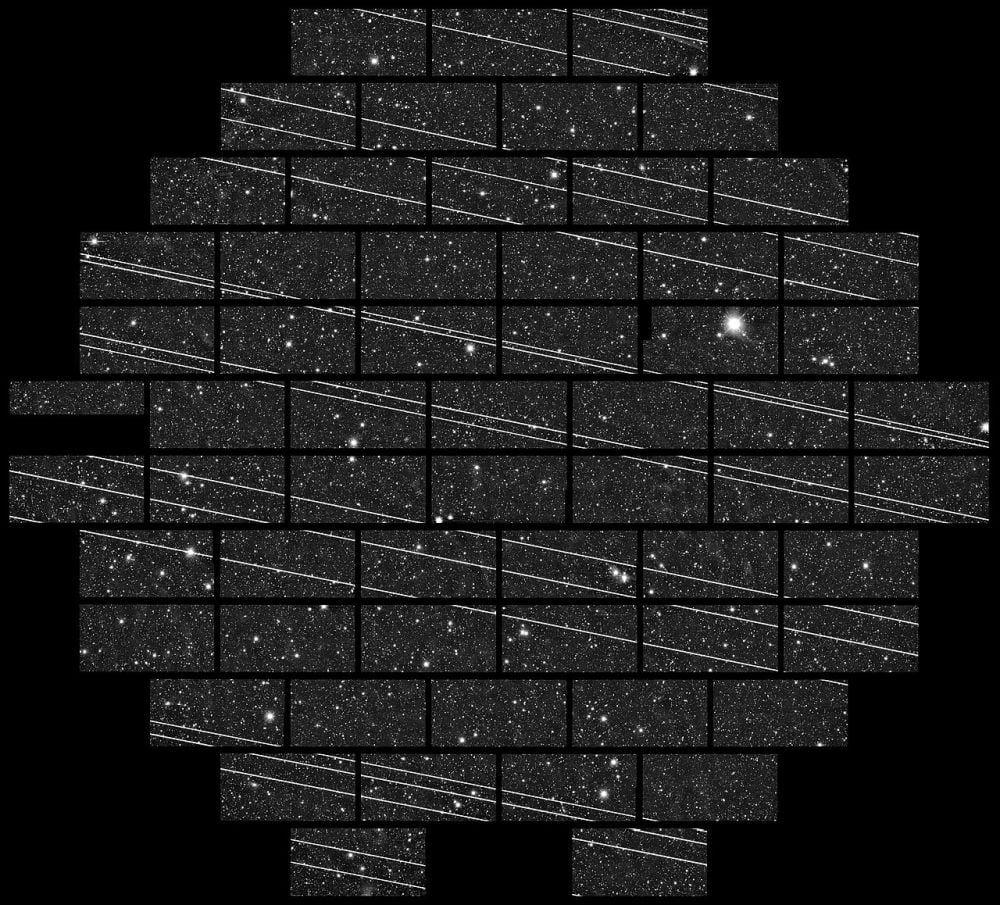
The researchers modeled a 300-second exposure with a spectrograph at ESO’s Very Large Telescope in Chile. In the SpaceX scenario, even 1.3 hours after astronomical twilight ended, satellite trails would affect observations across more than half the sky. Pointed straight overhead, the instrument would record more than eight trails per exposure on average. A 15-second exposure with the wider-field survey camera at the Vera C. Rubin Observatory showed a similar effect in the model.
Long exposures let astronomers collect enough light to study faint objects. Combining shorter exposures can help them work around individual trails, but it does not eliminate the light that satellites scatter across the sky. That light brightens the background against which astronomers must distinguish a faint source.
Reflect Orbital: the effect of brighter satellites
Reflect Orbital’s separate proposal would use orbiting mirrors to deliver sunlight to customers on the ground after dark. The study modeled how much of the Rubin camera’s field of view would be lost to trails from these unusually bright reflectors. One hour after sunset, the proposed 2030 constellation of 5,000 satellites would compromise about 3% of the field when the telescope pointed straight up and 12% when it pointed 30 degrees above the horizon. For the proposed 2035 constellation of 50,000, the corresponding losses rose to about 30% and 100%.
Even outside the reflectors’ intended beams, the researchers estimated that 5,000 satellites could increase the scattered sky background by 20–30% relative to a naturally dark sky. With 50,000, the modeled increase was 200–300%.
The authors recommended keeping individual satellites fainter than visual magnitude 7 at a reference distance of 550 kilometers. Even with that brightness limit, they recommended keeping the total population below roughly 100,000 so that losses from trails would not exceed those associated with typical telescope downtime. Neither recommendation is a regulatory limit.