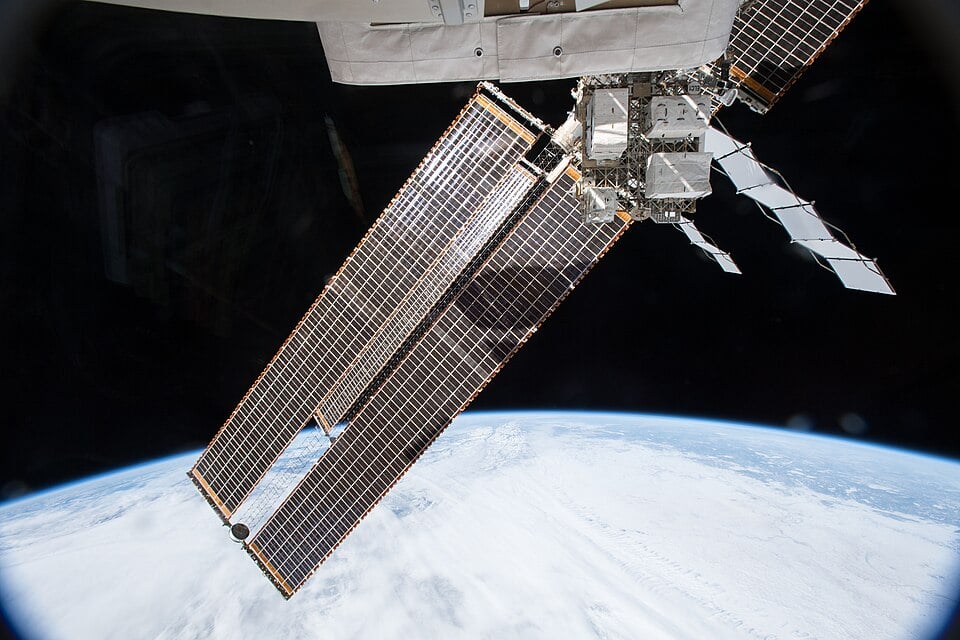
A one-megawatt AI data center in orbit would need about 5,640 square meters of solar panels to power its computers and another 2,500 square meters of radiators to shed their heat, estimates Slava Turyshev of NASA’s Jet Propulsion Laboratory. In an arXiv preprint, Turyshev examines whether access to sunlight can offset the cost of putting that equipment into space. His estimates suggest a stronger case for processing data satellites already collect than for moving Earth-based computing into orbit.
What has to go on the rocket. Turyshev’s one-megawatt design assumes a dawn-dusk orbit that minimizes time in Earth’s shadow. Even there, the power and cooling equipment alone would weigh about 30 metric tons. Structural supports, control thrusters and radiation shielding would bring the estimated spacecraft mass to 34–59 metric tons. These are design calculations, not measurements from an operating facility.
A spacecraft that size would not fit inside many rocket payload fairings, so Turyshev also considers a smaller design: a 100-kilowatt unit weighing about five metric tons. To illustrate the scale, the analysis uses a projected increase of roughly 17–46 gigawatts in U.S. data center power demand, drawing on research from Lawrence Berkeley National Laboratory. Meeting that increase in orbit would require an estimated 170,000–461,000 of the smaller spacecraft over five years. A Falcon 9 could carry at most four per launch under the assumptions used.
The cost threshold. The preprint puts the cost of a high-end terrestrial AI data center at $10,000–$40,000 per kilowatt of computing capacity. For an orbital design weighing 40 kilograms per kilowatt, matching that price would leave a budget of $250–$1,000 per kilogram for manufacturing and launch combined. The dedicated Falcon 9 launch price used in the comparison is about $3,360 per kilogram, before building any hardware.
Which workloads belong in orbit? An optical downlink can reach 200 gigabits per second without sustaining that rate. A satellite needs a clear line of sight to a ground station, and clouds can interrupt contact. The analysis puts sustained throughput at roughly 13–26 gigabits per second, a constraint for AI training that requires frequent synchronization with computers on Earth. Radiation-induced memory errors also take processor time to correct, while accumulated radiation damage and micrometeoroid impacts would degrade hardware over a five-year mission.
An Earth-observation satellite faces a different calculation: if it analyzes imagery on board, it can send selected results rather than entire raw images. Turyshev also identifies a possible role for processors aboard communications constellations such as Starlink, where solar arrays, optical links and ground stations already serve another purpose.
Companies are pursuing orbital computing, though their plans are not operating results. Universe Today reported that on November 25, 2026, the U.S. Federal Communications Commission approved SpaceX’s application to launch one million “Starmind” orbital data centers by 2040. It also reported that Google had booked a Blue Origin flight earlier that month to test its Project Suncatcher computing constellation. Neither the regulatory approval nor the test booking establishes what orbital computing will cost in practice.