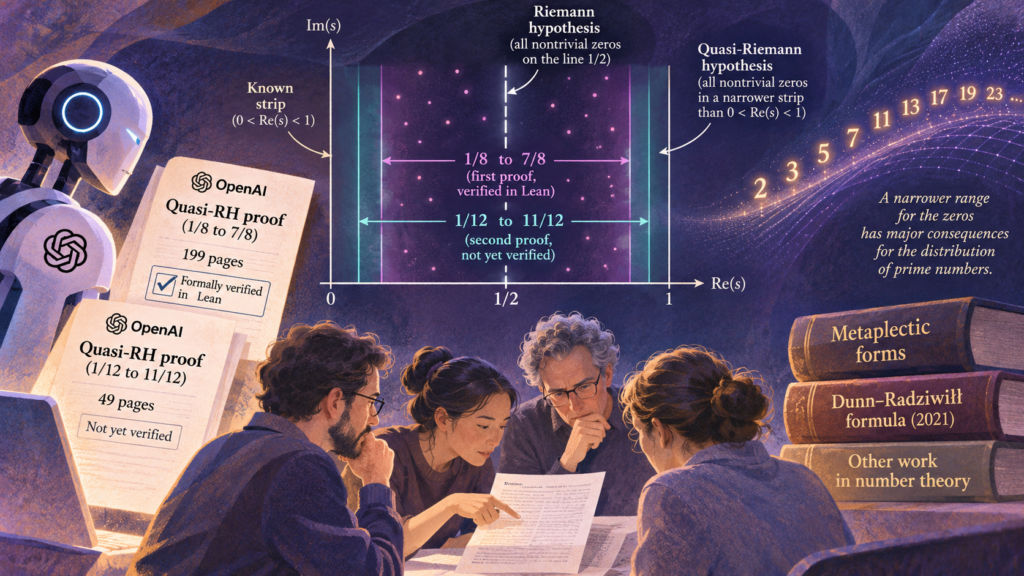
As of October 19, 2026, mathematicians were examining two AI-generated proofs announced by OpenAI that claim to establish versions of the quasi-Riemann hypothesis. The result concerns where the zeros of the Riemann zeta function can occur—and, through their connection to prime numbers, how precisely mathematicians can describe the distribution of primes.
The full Riemann hypothesis says that every nontrivial zero of the zeta function has a real part of exactly 1/2. That remains unproved. The quasi-Riemann hypothesis asks for a narrower range than the already-known interval between 0 and 1, rather than a single line.
OpenAI’s first proof, dated September 30, claims that every nontrivial zero has a real part between 1/8 and 7/8. Its 199-page argument was formally verified using the Lean programming language. A later, 49-page paper claims the wider interval 1/12 to 11/12; that argument had not been formally verified as of the reporting date.
Mathematicians have concentrated on the shorter paper because its argument is easier to examine. Experts studying it largely agreed that the result was correct, while noting that the papers’ exposition made them difficult to assess. Princeton mathematician Peter Sarnak said he would not consider the result a theorem until people had checked and understood all its details.
The apparent advance is not a new mathematical concept but an unexpected combination of existing ideas. The argument draws on work involving metaplectic forms and a formula proved in 2021 by Alexander Dunn and Maksym Radziwiłł, among contributions from other mathematicians.
A narrower range for the zeros would have substantial consequences for results that depend on the quasi-Riemann hypothesis. It would not, however, settle the full Riemann hypothesis. Number theorists interviewed at the time were unsure whether these methods could reach the required line at 1/2.