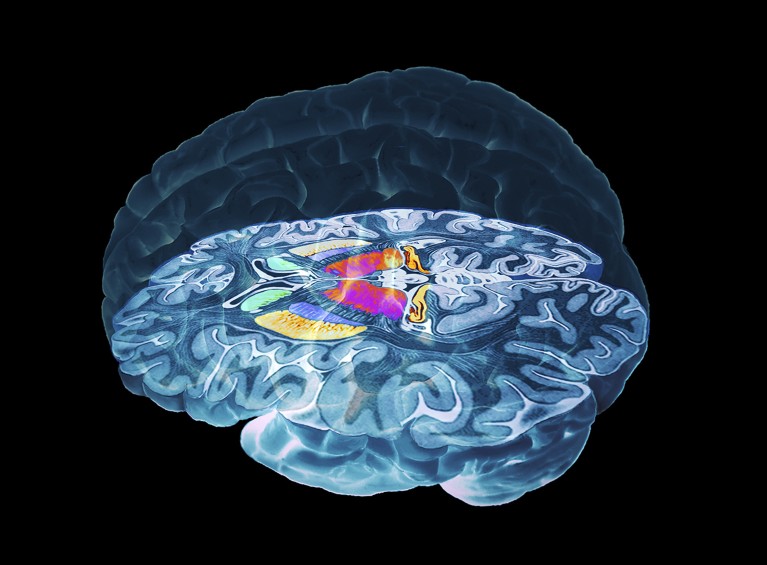
A new atlas of the basal ganglia maps 25.5 million brain cells from humans, macaques and marmosets. Reported on November 12, 2026, the work is described in 26 papers published across six journals, including Cell and Neuron.
The basal ganglia are deep-brain structures involved in movement, cognition, mood and decision-making. They are linked to conditions including Parkinson’s disease, Huntington’s disease and schizophrenia. The atlas is a reference for studying these structures, not evidence that any newly mapped cell type causes a disease.
Researchers assembled data from 21 million cells from six humans, three million cells from three rhesus and cynomolgus macaques, and 1.5 million cells from two marmosets. They also drew on previously published mouse-brain maps. Comparing the primates, they identified 61 cell types shared across humans, macaques and marmosets that have been conserved over an estimated 76 million years.
The project combines measures of gene expression, DNA modifications involved in gene regulation, electrical activity and other cellular features with maps of where cells are located. It is part of the US National Institutes of Health’s BRAIN Initiative Cell Atlas Network, a US$500-million project launched in 2022.
In one study, researchers examined 1.1 million cells from the striatum—a major part of the basal ganglia—of 19 deceased human donors. They identified six zones in the human and macaque striatum with distinct molecular signatures. The team also found that gene-expression differences between zones became less distinct with age, particularly in regions affected by Huntington’s or Parkinson’s disease.
Another study analysed nearly four million cells from the striatum and prefrontal cortex of 178 deceased adults aged 27 to more than 90. Cell populations varied between people, especially among non-neuronal cells called glia. That variation highlights a limit of any single reference map: it must account for differences between individuals.