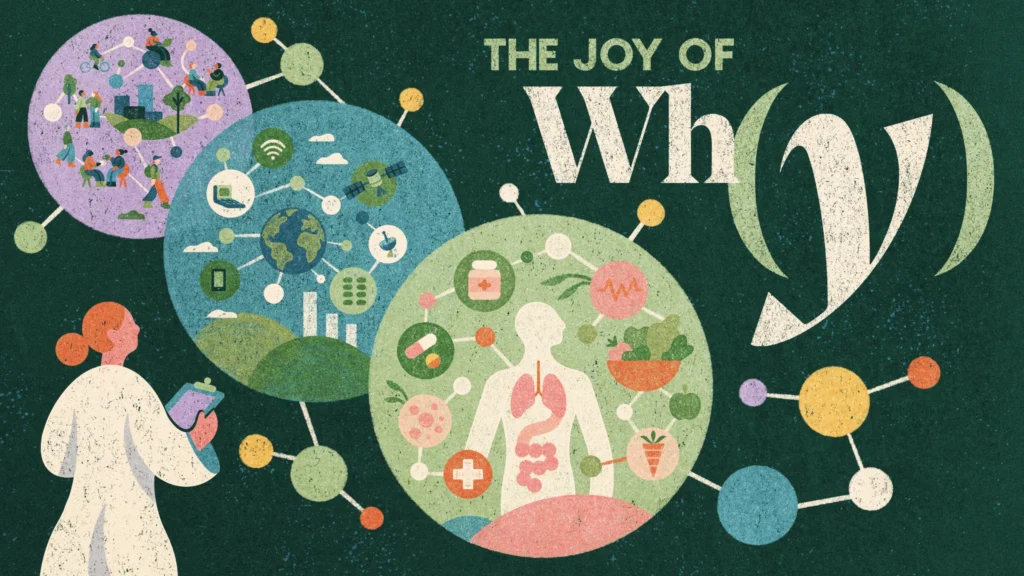
In a Quanta Magazine podcast published November 12, 2026 (UTC), network scientist Albert-László Barabási described how maps of molecular interactions might help researchers study disease and nutrition. The approach looks beyond individual genes or nutrients to ask how they connect with other parts of a system—and what happens when those connections change.
Barabási said his lab studies physical interactions, including proteins binding to one another and proteins binding to DNA. His group has found that genes associated with a disease tend to cluster in a network neighborhood, which he calls a disease module. Mapping that neighborhood could help researchers identify where a drug might act. The molecular maps are not complete, however, and a promising network target is not, by itself, evidence that a treatment works.
As an example of a clinical application, Barabási described a blood test developed by Cypher, a company he founded. He said it uses biomarkers and a classifier to predict whether a person with rheumatoid arthritis will respond to Humira. That account is a founder’s description of the product; the podcast did not provide independent performance data for the test.
The same interest in molecular connections led Barabási’s lab to its Foodome project. He said its current database contains about 135,000 food compounds outside the components tracked by conventional nutrition, which focuses largely on energy sources, building blocks and vitamins. He calls these less-understood compounds the “dark matter of nutrition.” The project aims to catalog them and investigate what they do in cells. Their presence in food does not establish a health benefit: according to Barabási, their effects are only beginning to be understood.