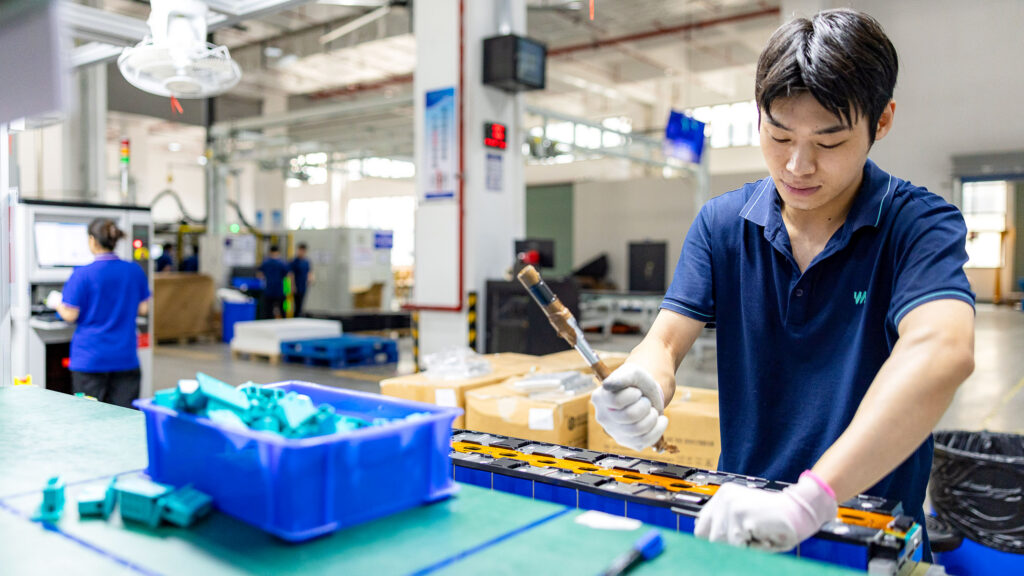
As reported on October 6, 2026, Beijing-based WeLion New Energy was producing semi-solid-state batteries for vehicles while working toward higher-capacity cells. Its technology uses an electrolyte that is part liquid and part solid. Fully solid-state cells could offer safety and energy-density advantages over conventional lithium-ion batteries, but they remain difficult to manufacture.
In 2023, WeLion and electric-vehicle maker Nio released a battery pack with a reported energy density of 360 watt-hours per kilogram (Wh/kg), compared with an average of about 200 Wh/kg for lithium-ion packs. The pack offered a range of more than 1,000 kilometers. High production costs limited output to about 200 packs, which WeLion said were still in use by Nio.
WeLion’s more ambitious figures are not yet commercial results. Its engineers tested a semi-solid-state cell that reached 824 Wh/kg in 2025, but the company said the prototype was far from commercialization and declined to provide further experimental details. Its charge-cycle life and capacity loss over time remain unclear. The tested cell’s figure should not be compared directly with the energy density of a complete battery pack.
As of the October 2026 report, WeLion planned to bring a 410 Wh/kg battery for drones to market by the end of 2026 and introduce its first all-solid-state car battery, expected to reach 400 Wh/kg, in 2027. Two inland cargo ships powered by WeLion batteries were also expected to launch in Huzhou in October 2026. According to the company, each ship’s pack would hold nearly 4,000 kilowatt-hours and provide a range of up to 250 kilometers. These were plans and company estimates, not completed launches or independently verified operating results.
WeLion reported 11 gigawatt-hours of annual manufacturing capacity across four Chinese production bases, with two more plants under construction. Scaling production and lowering costs remain obstacles: the company said its semi-solid-state batteries cost more than conventional lithium-ion batteries made by larger competitors.