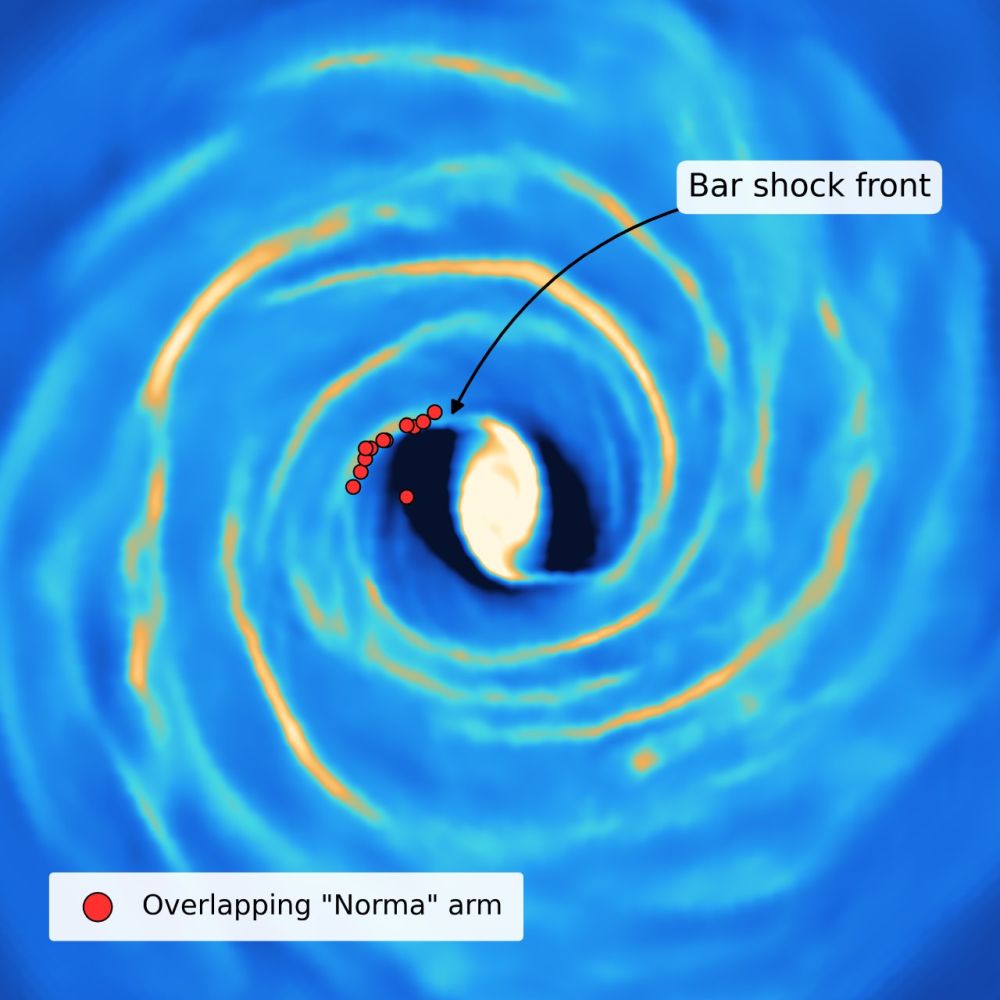
Astronomers have used microwave signals from young, massive stars to map what appears to be a stretch of the Milky Way’s Norma spiral arm. A study published in Nature Astronomy offers a different reading of those signals: they line up with a shock front predicted along the leading edge of the galaxy’s central bar. If that interpretation holds, stars are forming in the bar’s dust lane, and at least part of the feature mapped as Norma may not be a spiral arm.
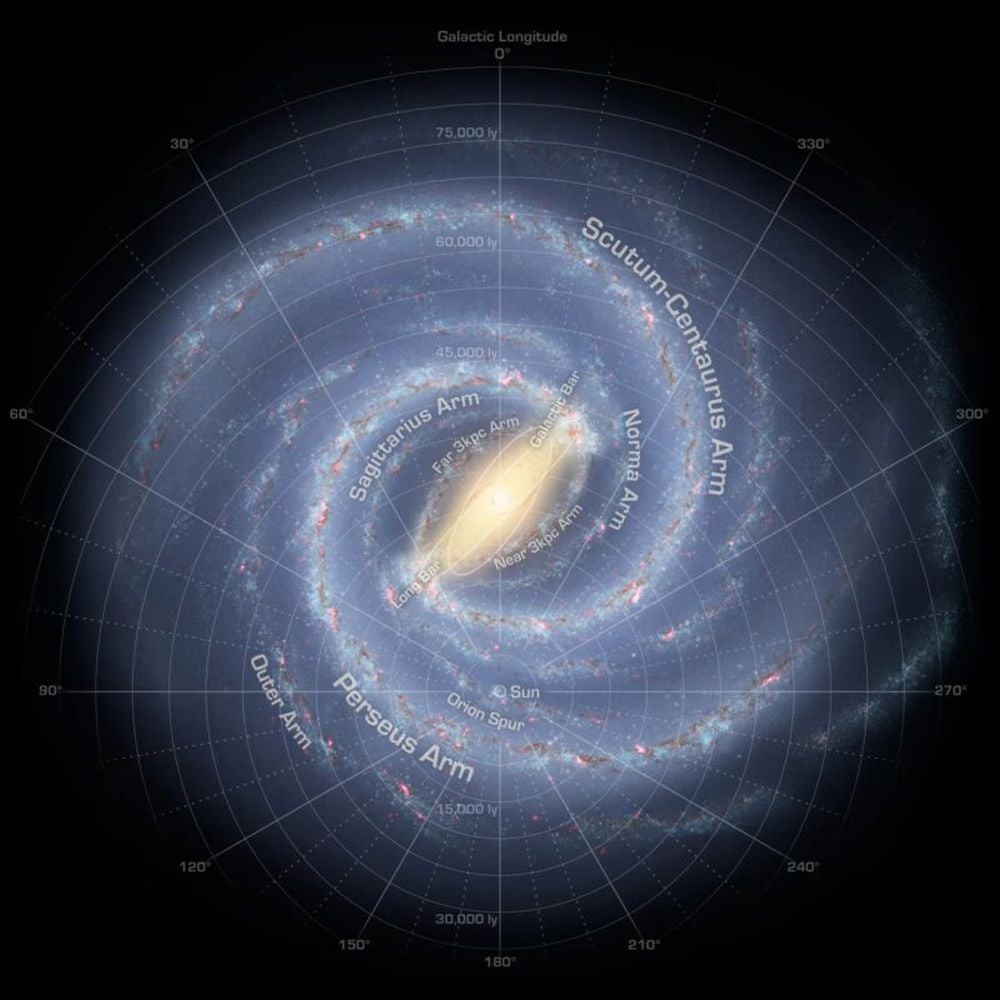
The signals, known as masers, trace star-forming regions much younger than a million years. At that age, the stars have had little time to move away from their birth clouds, so the masers mark where gas has recently formed stars. What is harder to tell is which galactic structure contains those clouds. From our vantage point inside the Milky Way, dust obscures the bar, an elongated structure of rotating stars near the galactic center.
Hilary Davis of the University of Sydney and colleagues in Australia and Sweden compared the observed maser positions with large-scale simulations of the galaxy. In the models, the rotating bar drives a shock that compresses gas along its leading edge. The predicted path of that shock closely matches the positions of masers previously assigned to Norma.
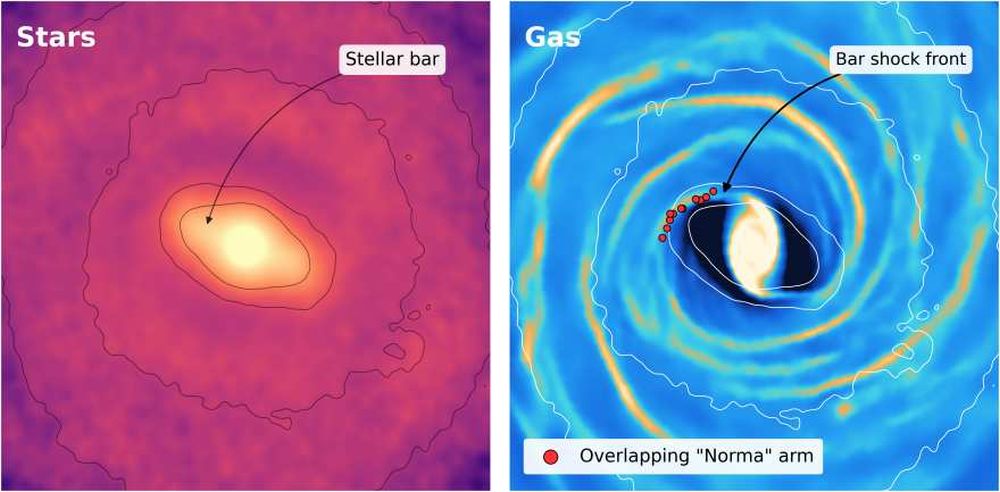
The distinction matters because stars commonly form along spiral arms, while gas in a galactic bar often experiences enough shear and turbulence to inhibit star formation. Where stars do form in bars, they tend to cluster near the ends. The maser alignment suggests that in the Milky Way, compression along the shock front itself may help gas form new stars.
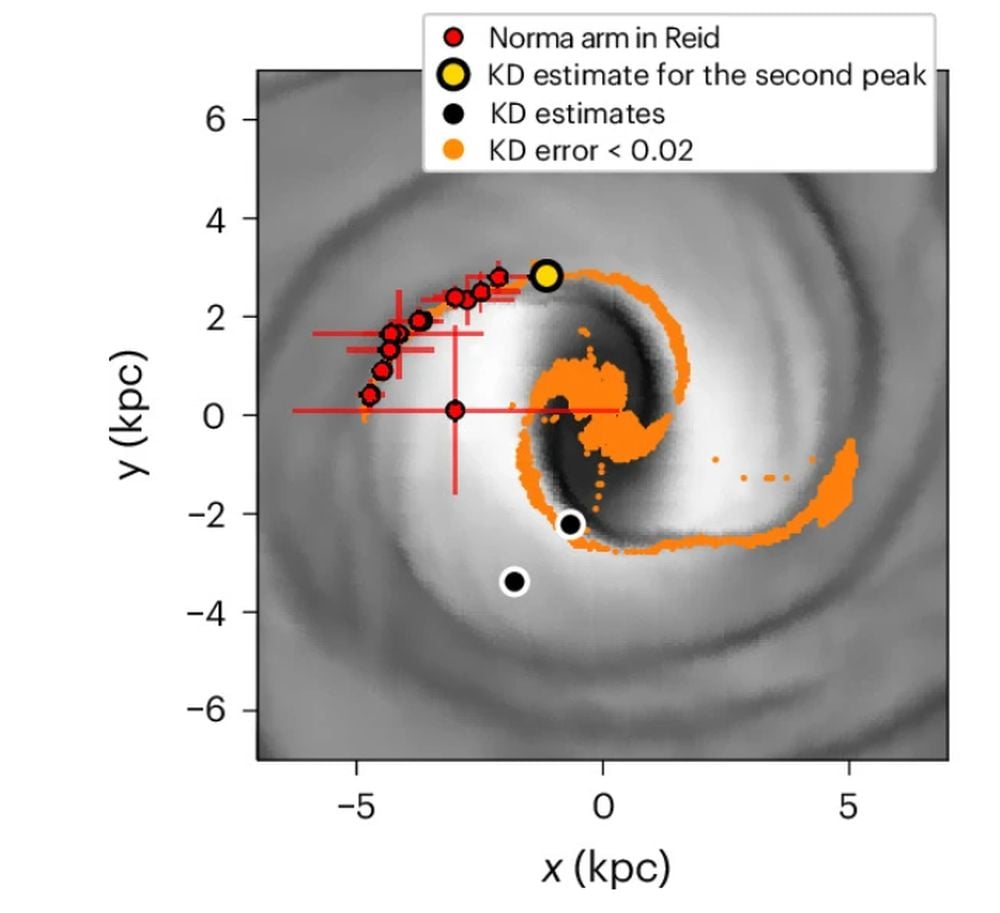
The same alignment also helped the team estimate the bar’s dimensions. Their model puts it at about 28,000 light-years long and 15,000 light-years wide, with its long axis tilted about 20 degrees from our line of sight. Those estimates depend on identifying the masers with the simulated shock front. The observations call into question the identity of the stretch of Norma traced by those masers, not the existence of the entire arm.