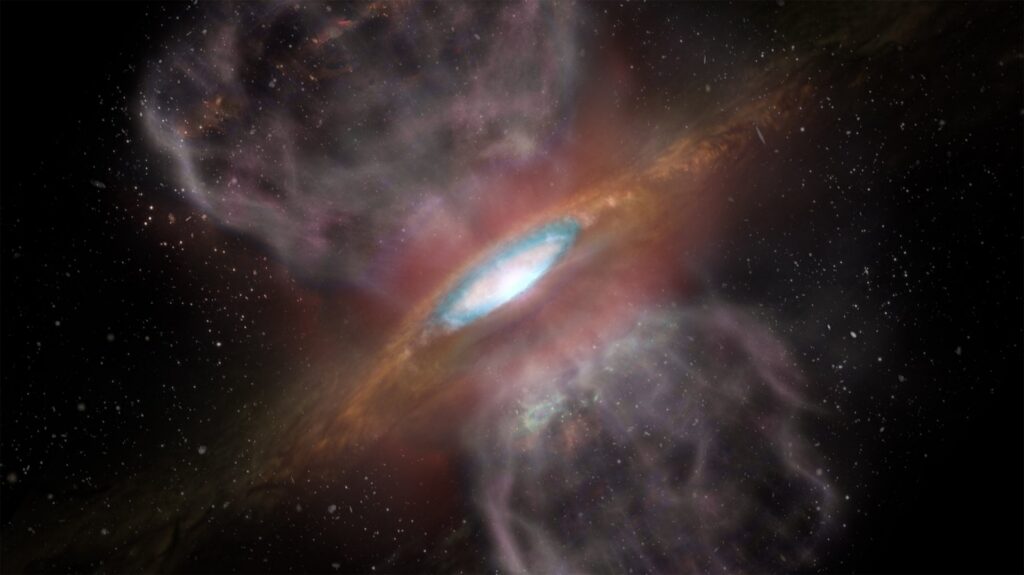
Astronomers have detected titanium oxide gas around Orion Source I, a massive protostar about 1,500 light-years from Earth that is still gathering material from its surrounding molecular cloud. The finding, published in The Astrophysical Journal Letters in 2026, is the first detection of gaseous titanium oxide around a young, massive star.
The team found the gas close to the protostar, at the base of an outflow where temperatures are high enough to vaporize rocky material. By contrast, the salty compounds astronomers detected around Orion Source I in 2019 were concentrated mainly in the outer disk.
“This object has a luminous enough star that it’s evaporating the rock. We’re seeing the rock evaporate from solid into gas, and so we can do the spectroscopy now and figure out what the rock is made of,” said Adam Ginsburg, a study co-author and associate professor at the University of Florida.
Some of the oldest solids recovered from our own solar system appear to have formed at high temperatures. In models of planet formation, heat-resistant compounds containing elements such as calcium, aluminum and titanium supply the first solid grains in a disk. These grains eventually become part of rocky planets, while more easily vaporized substances such as water accumulate later.
Where those first grains form remains uncertain. The observation at Orion Source I identifies titanium oxide in vapor, not grains forming. Measuring how much titanium oxide is present gives astronomers a way to compare rocky material around a still-growing star with the record preserved in solar system samples.