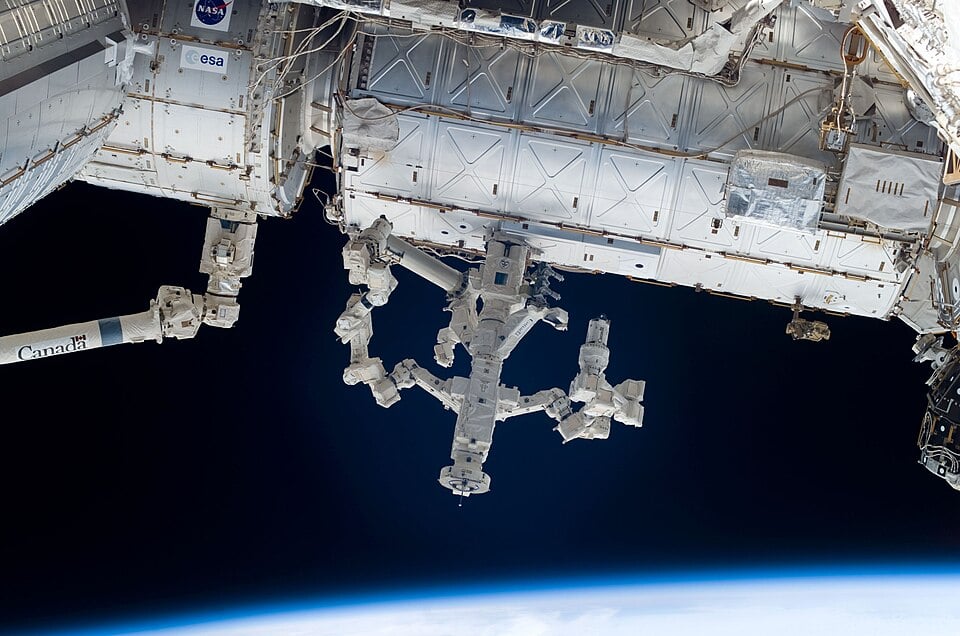
Keeping a one-megawatt AI data center running in orbit could take three or four specialized robots performing about 400 component swaps a year, according to an August 2026 arXiv preprint by Slava Turyshev, a physicist at NASA’s Jet Propulsion Laboratory. The estimate covers repairs and planned upgrades across ten 100-kilowatt satellites. It describes a proposed design, not the performance of an operating system.
AI chips and memory can fall behind the requirements for training the latest models in three to five years. Retiring a satellite when its processors become obsolete would mean discarding tons of solar panels and heat radiators that could still serve the next generation of chips. Turyshev proposes designing the hardware around what needs replacing, how often and by what kind of machine.
What the robots would replace
In Turyshev’s design, automated cartridge changers would swap out 5-kilowatt computing modules containing processors, memory, storage and optical transceivers. These modules would need the most frequent attention: even before a scheduled upgrade, a cosmic ray could disable one.
Robotic arms with six or seven degrees of freedom would handle less frequent replacements of power converters, batteries, pumps and manifolds. Solar arrays and radiator panels would also come in replaceable sections, so a micrometeoroid strike need not cost a satellite its entire power or cooling system. Replacing a whole 100-kilowatt satellite would remain an option after catastrophic damage.
Even a routine swap would have to account for heat and stored electricity. Turyshev estimates that without cooling, a 5-kilowatt processor would heat up by nearly half a degree Celsius per second and reach thermal overload in just under a minute. Power capacitors would need to discharge before a robot touched the hardware: an electrical arc could weld its gripper to the contact point.
The cost of keeping up
At one gigawatt, comparable in power to a major terrestrial AI campus, the projected workload rises to about 400,000 automated replacements a year. Supplying the parts could require launching up to 25 metric tons of cargo a day. Robots could do the work in orbit, but they would not solve the problem of getting replacements there.
A resident maintenance crew would introduce different demands: pressurized work areas, airlocks, life support and fire suppression. Turyshev estimates that housing and feeding four to six technicians would cost $500 million to $1.5 billion annually. His analysis leaves room for occasional crewed repair missions but suggests that a resident crew would be difficult to justify economically below several hundred megawatts to a gigawatt. Even at that scale, the volume of routine swaps would remain the case for designing the satellites around robotic servicing.