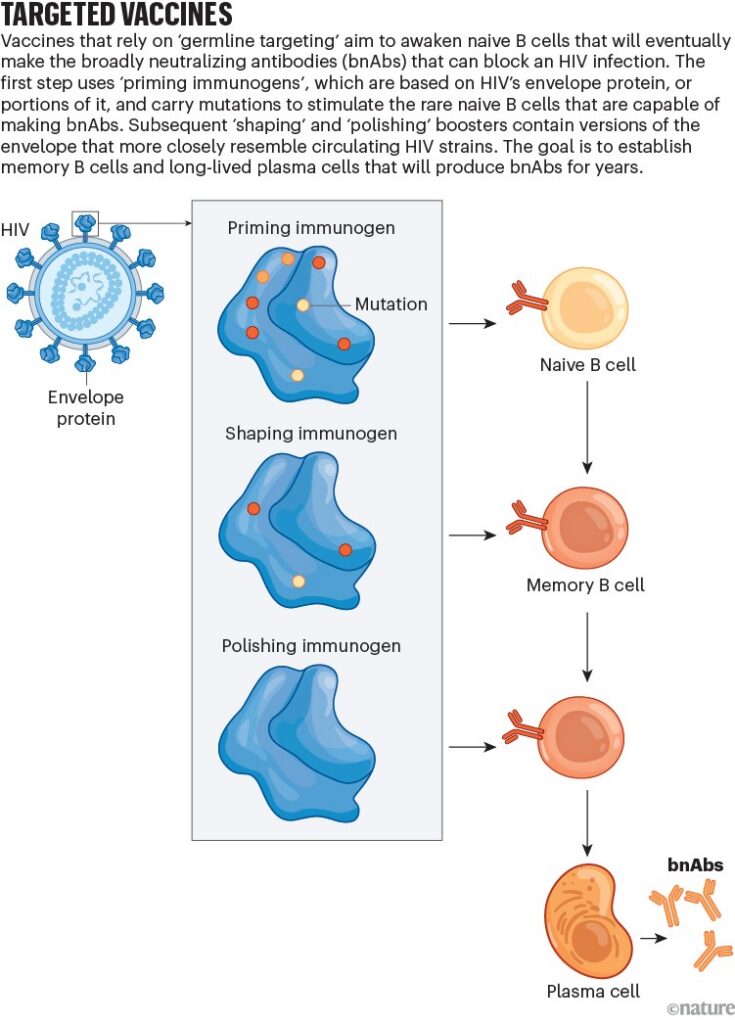
Several research teams reported in 2026 that experimental vaccines prompted monkeys to produce antibodies capable of blocking a wide range of HIV strains. Small human trials have reached an earlier step: vaccine components elicited precursors to these broadly neutralizing antibodies, and a booster helped the antibodies mature. Neither finding establishes that vaccination prevents HIV infection in people.
Breadth matters because HIV changes rapidly. Beginning in the 1980s, researchers tested vaccines based on the envelope protein that HIV uses to attach to human T cells. The vaccines elicited antibodies, but most circulating strains could still cause infection. A trial in Thailand reported modest signs of protection in 2009 with a vaccine that stimulated both antibody and T-cell responses, but later trials did not reproduce the result.
What one participant’s antibodies revealed
In the mid-2000s, a young woman in South Africa’s KwaZulu-Natal province joined a study of newly acquired HIV infections. Over several years, the participant, known as CAP256, developed some of the most potent antibodies against HIV yet identified. She still needed drugs to control her infection. For vaccine researchers, the question was whether an uninfected person could develop similarly potent antibodies before exposure.
Regular blood samples from CAP256 helped researchers trace how her antibodies matured as the virus changed. Penny Moore, a virologist in Johannesburg who analysed the samples, describes a prolonged contest between the virus and the immune system. One vaccine approach, known as germline targeting, aims to reproduce the learning process without infection: an initial dose activates rare B cells capable of producing promising antibodies, and later doses guide those cells towards making antibodies that recognize more strains.
What the human trials show
In small trials, nearly all participants who received either a protein or an mRNA version of a vaccine component called eOD-GT8 produced antibody precursors. Designed by a team led by William Schief at Scripps Research, the component targets B cells whose antibodies can recognize the site HIV uses to attach to T cells. The precursors had the desired genetic and structural features but lacked many of the mutations found in mature broadly neutralizing antibodies. In participants who received a different vaccine component as a booster, the antibodies acquired mutations that improved binding and neutralization.
A separate candidate inspired by CAP256’s immune response showed promise as an initial dose in monkeys and was being tested in humans as of November 2026, according to George Shaw of the University of Pennsylvania, who co-led the preclinical work with Beatrice Hahn.
Researchers now have an immune response they can measure as they refine vaccine candidates, rather than relying solely on large trials to find out whether a strategy has promise. Demonstrating protection remains a separate challenge. Effective preventive drugs such as lenacapavir could make vaccine efficacy harder to assess, and US funding cuts have put some preclinical and clinical HIV research efforts at risk.