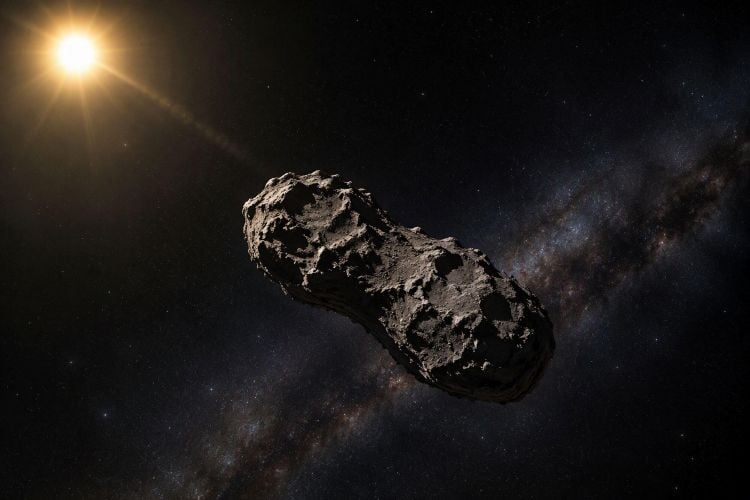
Astronomers in Japan used archival observations from the Subaru Telescope to distinguish the heat emitted by Comet 2P/Encke’s nucleus from the glow of the material around it. In a study published in The Astronomical Journal, the team estimated that the nucleus measures about 7 kilometers by 3 kilometers and that its surface was about 328 kelvin (55°C) at the time of observation.
Subaru’s Cooled Mid-Infrared Camera and Spectrometer (COMICS) observed Encke in November 2003, when the comet came within 0.26 astronomical units of Earth and was about 1.09 astronomical units from the Sun. As sunlight warms a comet, ice turns to gas, and the growing cloud of gas and dust makes it harder to tell how much of the observed signal comes from the solid nucleus. Isolating that signal allowed the team to estimate the nucleus’s dimensions and temperature.
“Our study of Comet Encke showed that mid-infrared observations can directly capture thermal emission from the nucleus itself,” said lead author Takafumi Ootsubo of Japan’s University of Occupational and Environmental Health.
Subaru retired COMICS in 2020, leaving the telescope without a mid-infrared instrument. Ootsubo is working to restart COMICS so researchers can study the shapes, temperatures and surface materials of other cometary nuclei.