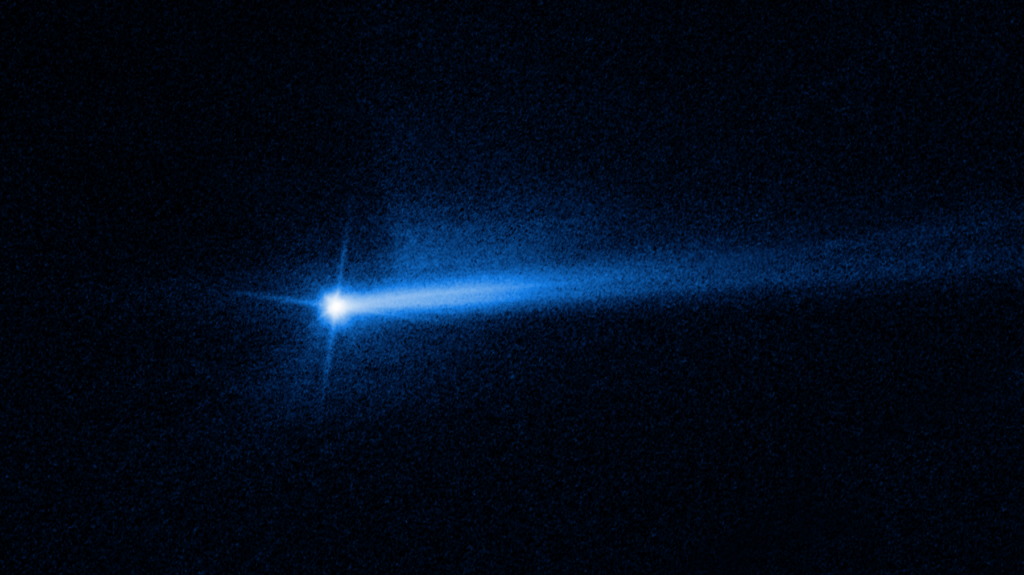
The European Space Agency’s Hera spacecraft has reached the asteroid pair where NASA tested whether a spacecraft could deflect an asteroid. The 2022 DART impact shortened the time Dimorphos takes to orbit its larger companion, Didymos, by about 33 minutes. What scientists still do not know is whether DART left a crater or reshaped the entire asteroid.
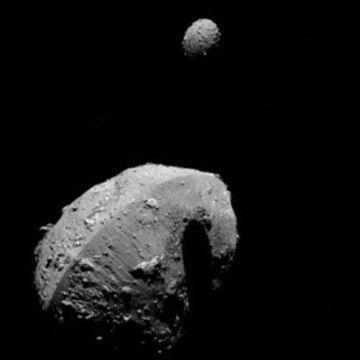
Hera has sent back a view of Didymos with Dimorphos in the background. The first images from the investigation were scheduled for release later on Wednesday, 25 November 2026.
What the orbit tells scientists
Dimorphos is about 150 metres wide and poses no threat to Earth. Before the test, it took 11 hours and 55 minutes to circle Didymos, which is about 730 metres wide. DART struck the smaller asteroid at about 22,000 kilometres per hour. Telescopes on Earth and in space detected a debris trail roughly 10,000 kilometres long.
The shorter orbit showed that the collision had changed Dimorphos’s path. But DART was destroyed on impact: its final images showed the boulder-covered surface on approach, not the aftermath. Patrick Michel, Hera’s principal investigator, said that if the team finds a crater, it will need to measure its width and depth. It is also possible, he said, that the impact changed the shape of Dimorphos as a whole.
Why Dimorphos’s mass matters
Hera is due to spend about a year studying Dimorphos and examining Didymos. It carries two shoebox-sized satellites designed to inspect the impact site up close and later land on the asteroid. One of the mission’s key measurements is the mass of Dimorphos: combined with the observed change in its orbit, that will help scientists work out how much of a push DART delivered.
That distinction matters if an asteroid is ever found on a collision course with Earth. Simon Green, a planetary scientist on Hera’s science team, said the results could help researchers estimate how heavy a spacecraft would need to be, how fast it would have to travel and how far in advance it would need to strike for the asteroid to miss Earth.
Carolyn Ernst of the Johns Hopkins Applied Physics Laboratory, who works on both missions, said the largest asteroids have been spotted and none is heading for Earth. The atmosphere protects Earth from the smallest objects, but not all mid-sized asteroids have been found. An asteroid about the size of Dimorphos could destroy a city.
The Near-Earth Object Surveyor space telescope is scheduled to launch in 2027 to track potentially hazardous asteroids. A separate opportunity to study one up close will come on 13 April 2029, when Apophis, an asteroid about 450 metres long, is expected to pass about 32,000 kilometres above Earth’s surface. Early calculations after its discovery in 2004 raised the possibility of a collision in 2029, but scientists now say it will not hit Earth for at least 100 years. NASA’s OSIRIS-APEX and Ramses, a joint European and Japanese mission, are both slated to study it.