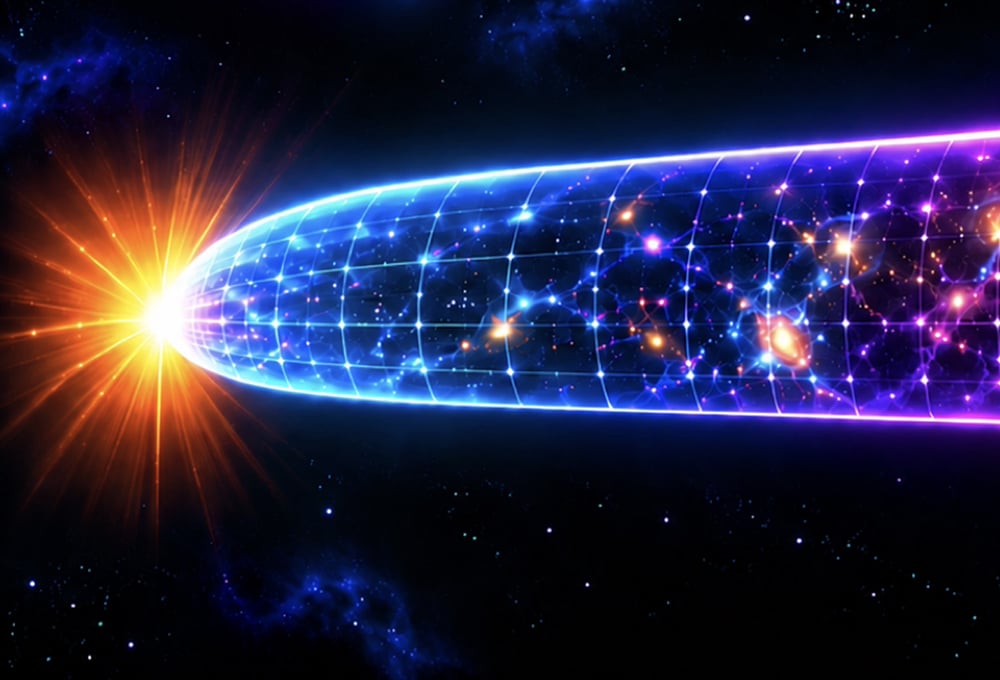
Researchers at the University of British Columbia and the University of Sheffield have proposed that the physics that binds quarks inside protons and neutrons could also help explain why the universe’s expansion is accelerating. Their theoretical model fits astronomical observations about as well as standard cosmological models do, the team reports. That makes it a possible explanation for dark energy, but the data do not establish it as the cause.
Dark energy is the name physicists give to the still-unexplained component that drives accelerated expansion. It accounts for about 70 percent of the universe’s energy budget. The researchers looked for its origin in quantum chromodynamics (QCD), the part of the Standard Model of particle physics that describes the strong force.
The proposed connection depends on what happens to the strong force’s quantum fields in space devoid of matter. Those fields are still present, and the team proposes that their vacuum state responds to cosmic expansion. In the model, that response produces a small shift in vacuum energy that could account for the acceleration.
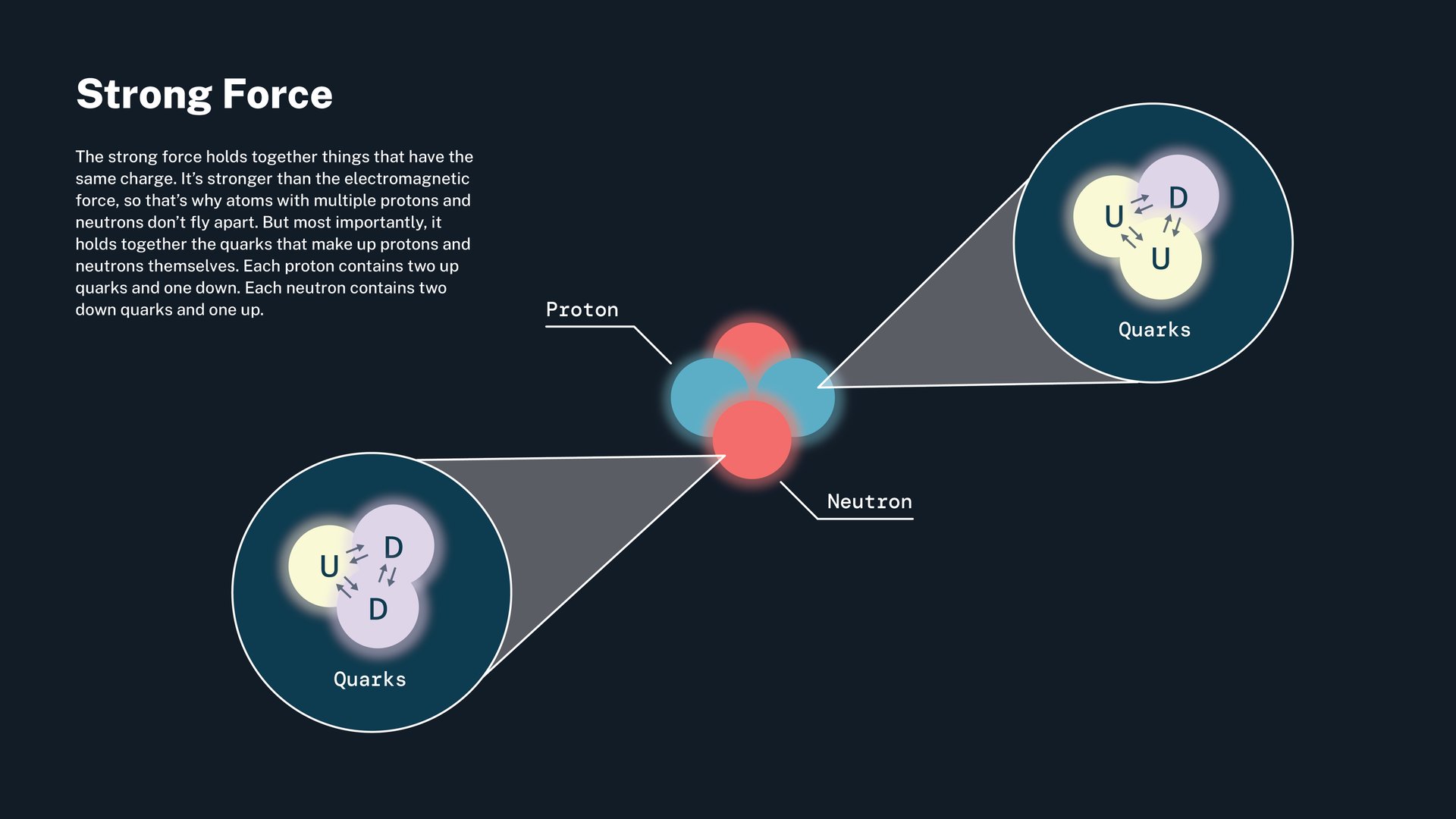
Ariel Zhitnitsky of the University of British Columbia, who developed the theoretical framework, said the energy scale predicted from the QCD vacuum and gravity is close to the dark-energy scale observed in the present-day universe. The calculation does not require a new particle, field or adjustable parameter to reach that scale, he said.
The team compared the model with observations including light from distant supernovae and radiation left over from the early universe. Dong Ha Lee, who led the team, said the model can reproduce a change in dark energy over time that the observations suggest. Whether dark energy actually evolves remains an open question.
The researchers plan to refine their calculations of how the QCD vacuum responds to expansion and develop predictions that future observations could test. Data from the Nancy Grace Roman Space Telescope could help distinguish their proposal from other explanations.