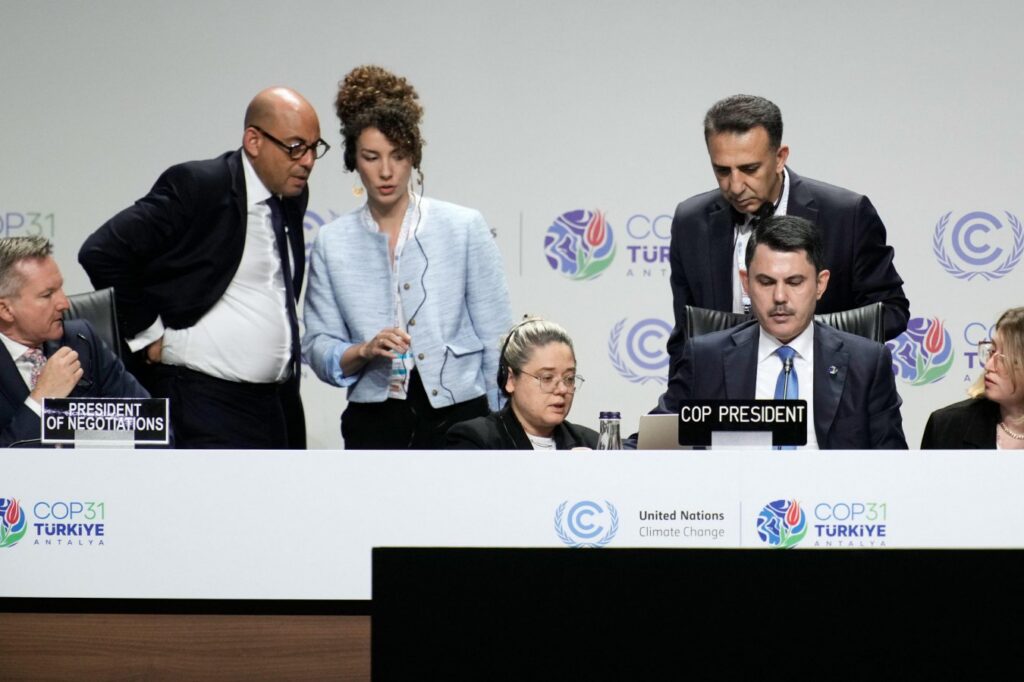
New Scientist reported on 23 November 2026 that the COP31 climate summit in Antalya, Turkey, ended in disarray late on 22 November 2026. After two weeks of negotiations, countries including the United Kingdom and the European Union refused a political accord that did not mention fossil fuels.
The proposed Antalya text was not adopted. It would have had countries officially recognise that the world is on course to exceed 1.5°C of warming and promise to limit the scale of that overshoot as far as possible. It would also have committed nations to raising electricity’s share of total final energy consumption to 35 per cent globally by 2035.
The draft became unacceptable to the UK, the EU and some small island nations after references to fossil fuels were removed at the request of fossil-fuel-dependent countries, including Saudi Arabia and Russia. The EU argued that omitting fossil fuels would have been a step backwards. At COP28 in Dubai three years earlier, nations agreed to “transition away from fossil fuels”. The report says later attempts to strengthen that language, or to set out how the transition would happen, have been blocked by petrostates.
Alden Meyer of the climate think tank E3G said fossil-fuel-exporting states used a “brutish” strategy to “systematically block” any reference to the COP28 deal. “They clearly have buyer’s remorse about that agreement. They never were happy about it,” he said.
The EU also objected to a paragraph inserted at the request of Saudi Arabia, which leads the 22-member Arab group. That paragraph called for carbon capture and storage to grow rapidly to the gigatonne scale by 2035. The report describes those technologies as expensive and unproven at scale, and says many sceptics fear that emphasising them could justify continued fossil-fuel use and distract from the deep emissions cuts needed to limit warming.
Ireland’s climate minister Darragh O’Brien, speaking for the EU, said the negotiations had been “hijacked by fossil fuel producers” and that the EU would “not accept a COP that greenwashes fossil fuels”.
Parties also criticised the hosts. Turkey and Australia shared the presidency, which the report says made the final days sluggish and disjointed. Lower-income countries were unhappy that richer countries offered no new climate-finance commitments.
The account recalls a longer pattern. When the COP process was established in 1992, oil-exporting countries insisted that UN climate decisions be taken by consensus, which has given every country an effective veto. Other tactics described include delaying meetings with objections and points of order, and adding extra items to the official agenda.
Joanna Depledge of the University of Cambridge, described as a long-standing COP observer, said the new feature at COP31 was that a group such as the EU abandoned a deal instead of accepting a weak compromise in the name of progress. “The usual political dynamics were completely upended,” she said. “Usually the EU always backs down at the end. It doesn’t want to be seen as a blocker, but this time it played hardball.”
Bill Hare, chief executive of Climate Analytics, called the proposed deal “clearly unacceptable”. In a statement, he said the lack of agreement on the main document should not be seen as a failure of the COP process, but as “a successful defence of the UNFCCC’s integrity against a coordinated attack by a few countries implacably opposed to action on climate change, in particular to any mention of the need to transition away from fossil fuels”.
The report treats the no-deal outcome as poor news for the pace of climate action, not as a settled success. It says an apparent global consensus is fragmenting even as climate impacts increase and renewable energy and electric technologies spread. It also describes growing scepticism about “cover decisions”, the political texts wrapped around the formal talks. With countries unable to agree even to mention fossil fuels, the piece questions what use a cover text has if it cannot strengthen the signal sent to the rest of the world.
The next summit is due in Addis Ababa, Ethiopia. The report judges that those hosts are highly unlikely to risk pushing for a cover decision, and suggests that if bold steps cannot be agreed unanimously, large groups of countries may proceed anyway. On that view, later COPs would focus more on the “action agenda”, where groups voluntarily make pledges and publish roadmaps for cleaner technologies. Whether that would be as powerful as a single message backed by all nations is left as doubtful. These are assessments in the reporting, not decisions already taken.
Meyer said work continued outside the failed cover text. Seventy countries agreed to accelerate electrification of their economies, and countries including Brazil, Denmark and Spain presented roadmaps for removing fossil fuels from their economies. “In the real world, there’s a lot of progress,” he said. He suggested the breakdown “may serve as a wake-up call to the vast majority of countries that want to see progress on climate change”.
The report also points to signals outside the negotiations. It says renewable capacity has kept growing faster than analyst predictions, and that electric vehicles are reaching adoption tipping points in a growing number of countries. It says the International Energy Agency reported the previous week that the Iran conflict had underlined, for many governments, the security value of domestic power compared with imported fossil fuels, with solar and nuclear the main beneficiaries. The piece says decarbonisation is still not nearly fast enough, but that the broader direction of change is clear, and that COP31 has brought disputes that were previously managed through careful wording into the open.