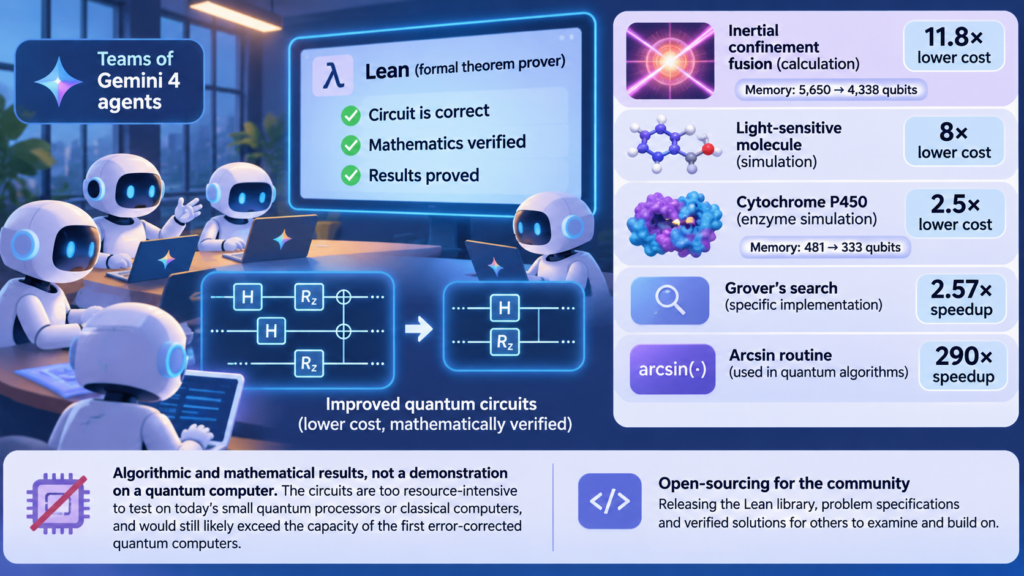
In a report published on November 24, 2026, Google DeepMind and Google Quantum AI said teams of Gemini 4 agents had found ways to reduce the estimated resources needed for several quantum algorithms. The teams used Lean, a formal theorem prover, to check the mathematical correctness of their proposed circuits.
For a calculation relevant to inertial confinement fusion, the researchers reported an 11.8-fold reduction in a cost measure combining qubits and operations. The estimated memory requirement fell from 5,650 to 4,338 error-corrected qubits. They also reported an eightfold cost reduction for simulating a light-sensitive molecule and a 2.5-fold improvement for a simulation involving cytochrome P450, an enzyme involved in metabolizing many medicines. In the latter case, the estimated memory requirement fell from 481 to 333 qubits.
The team reported a 2.57-fold speedup for a specific implementation of Grover’s search algorithm and a 290-fold speedup for an arcsin routine used in quantum algorithms.
These are algorithmic and mathematical results, not demonstrations on a quantum computer. The researchers said the circuits are too resource-intensive to test on today’s small quantum processors or classical computers, and that scientific simulations using them would still likely exceed the capacity of the first error-corrected quantum computers. The team said it is releasing its Lean library, problem specifications and verified solutions for others to examine and build on.