A 2026 preprint describes an experiment in which slices of donated human brain tissue were connected to a robotic hand and trained to associate piano notes with key presses. The result is evidence of activity-dependent adaptation in the tissue—not evidence that it understood music or was conscious.
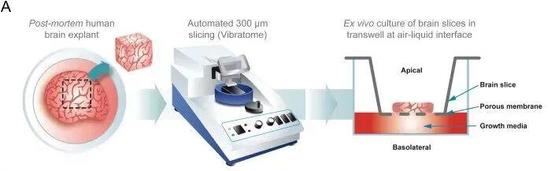
Researchers at the University of Montpellier obtained motor-cortex tissue from three deceased donors. The tissue was collected within 12 hours of death and brought to the laboratory for culture within 30 minutes, according to the original report. They prepared 30 slices, each 300 micrometres thick, preserving cortical layers and some white matter. This postmortem adult brain slice preparation differs from a brain organoid grown from stem cells. Earlier work by the team, published in 2024, had reported synaptic plasticity in such slices.
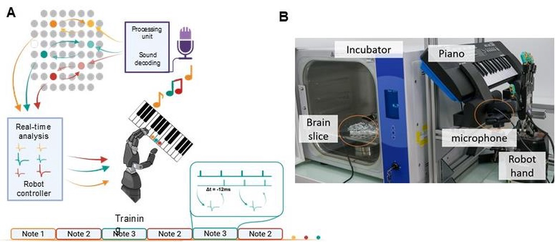
For the new experiment, activity at three designated electrodes controlled three fingers of a robotic hand. When a finger pressed a piano key, the resulting sound was converted into an electrical signal and fed back to the slice through sensory electrodes. Training ran for three days, with about 300 pairings per day. The researchers then tested whether a slice receiving a note’s signal would activate the electrode corresponding to that note.
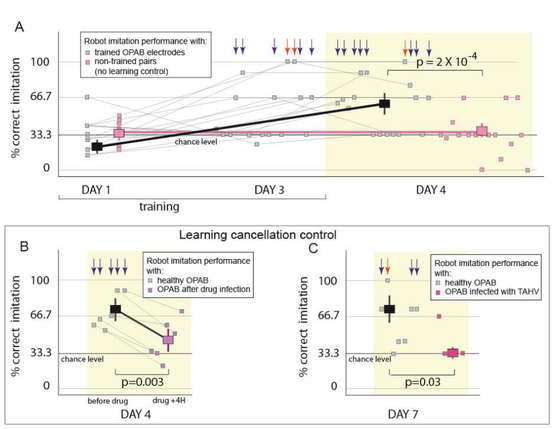
Of the 16 slices in the core experiment, three imitated all three notes correctly and seven imitated two. Thus, 10 of 16 imitated at least two notes. The reported association lasted at least seven days, and some samples still responded after 17 days. Untrained connections did not produce imitation; blocking synaptic transmission disrupted it; and slices infected with a neurotropic virus did not learn the task. These controls support a role for synaptic activity, though the findings are described in a preprint, not as a peer-reviewed result.
The work also raises questions about how consent for donated tissue covers prolonged culture and experiments involving learned responses. The original report says the study had hospital ethics approval, permission from France’s biomedicine agency, authorization from a local prosecutor and no objection from donors’ families. It does not establish that the slices had awareness; the preprint’s authors explicitly say they did not.
Source: guokr.com (originally published 2026-11-13 06:15 UTC+8)